In honor of Pvt. Nathan R. Oakes, CSA

150 years ago, my great grandfather, Nathan Richardson Oakes, served as a private in Company D of the distinguished 32nd Mississippi Infantry Regiment in the Army of Tennessee. He participated in the great Civil War campaigns, including the battles of Perryville, Murfreesboro, Chickamauga, Atlanta, Franklin, Nashville, and Bentonville. I am writing about his engagements as well as some details about fighting for the Lost Cause. I hope to honor him and commemorate the events and individuals that contributed to making this a renowned unit in the Confederate Army of Tennessee.

Sunday, November 24, 2013

Lookout Mountain, "The Battle Above the Clouds"

On this date in 1863, Federal troops scaled the heights of Lookout Mountain, southwest of Chattanooga, in a "battle above the clouds," and captured the Confederate position there.1 

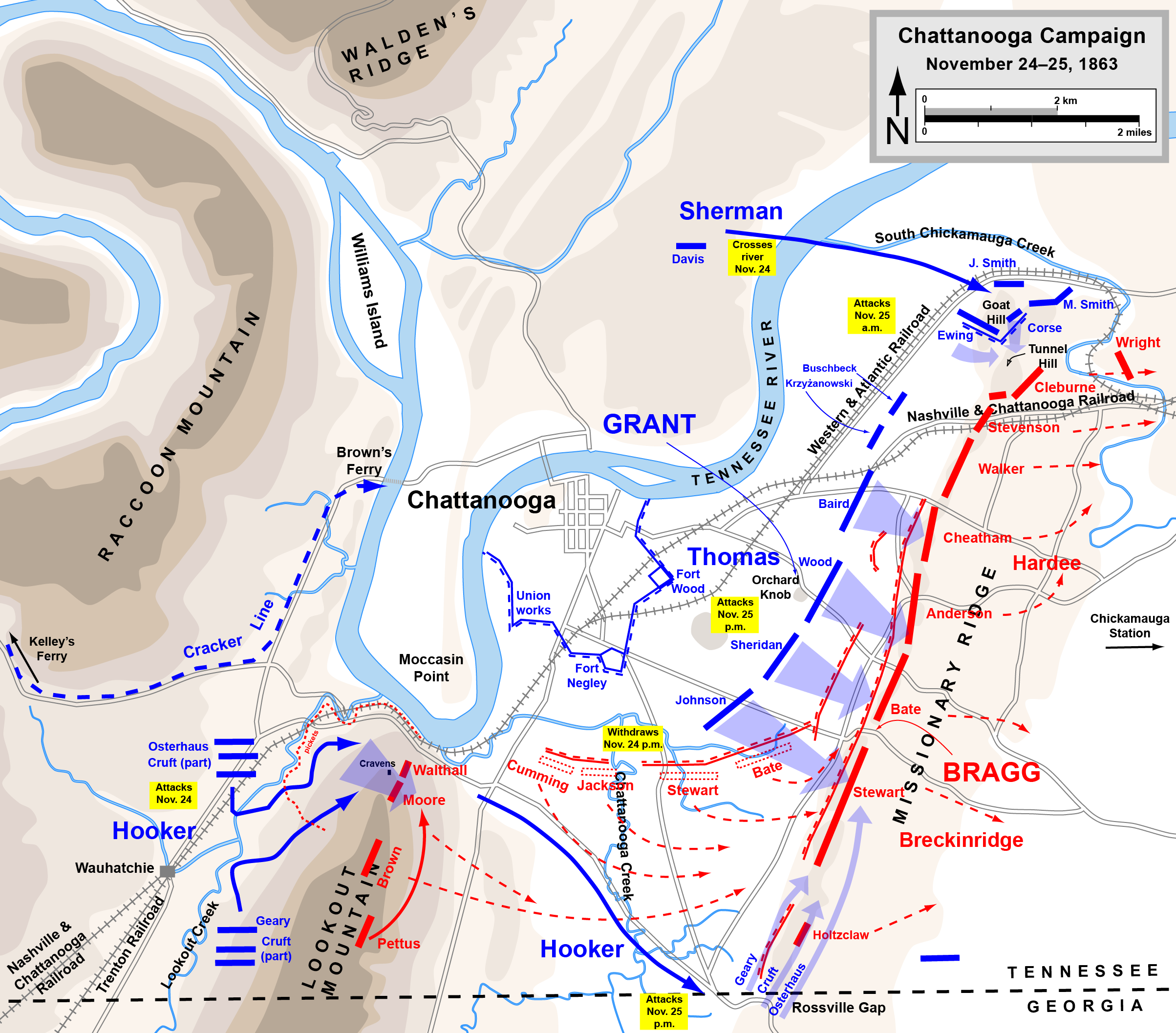
By the end of the day, yesterday, Union Maj. Gen. Ulysses S. Grant's forces under Maj. Gen. George Thomas, attacked the center of the Confederate line on Missionary Ridge, and succeeded in taking Orchard Knob in front of the ridge. Maj. Gen. William T. Sherman attacked the north end of the Confederate line but was not able to overtake their strategic hold at the north end of the ridge where Great Grandfather Oakes is serving with Cleburne's Division in Lowrey's Brigade.

Source: Civil War Maps by Hal Jesperson

Lookout Mountain lay on the Union's far right. Union Gen. Joseph Hooker advanced his men toward the fog-covered peak, attacking Confederates posted at the base of the mountain.2 Hooker didn't actually plan to attack the entire mountain that day, thinking the steep granite slopes too precipitous to overcome quickly. However, fog masked the Union advance, and Hooker's men were able climb more easily than imagined. One Federal officer, Daniel Wait Howe, wrote, "During a considerable part of the day it was so foggy that we could see only the flashing of the guns, but at intervals the fog lifted, revealing the Federal line in the distance looking like a dark thread, slowly advancing from rock to rock. Then cheer after cheer went up from our own lines, for it was obvious that the Federal troops were steadily but surely gaining ground. Far into the night the flashes of musketry indicated that the weird 'battle among the clouds' had not ceased."

The Confederates at Lookout Mountain had overestimated the advantages offered by their position up the steep slopes, and 1,200 Rebels faced nearly 12,000 attacking Yankees. Artillery proved of little use, as the hill was so steep that the Rebels could not see their attackers until they suddenly appeared. Gen. Braxton Bragg did not send reinforcements because he believed the Union attack on the Confederate line on Missionary Ridge was more threatening than what was happening at Lookout Mountain.3

The Federals were victorious, and the Confederates were forced to abandoned the mountain by evening. In their withdrawal they were successful in destroying critical bridges over the Chattanooga Creek, thus separating Hooker's troops from the Confederates on Missionary Ridge. Their action will also significantly slow down Hooker's advance tomorrow on the south end of Missionary Ridge at the Rossville Gap.

The taking of Lookout Mountain was a huge morale boost to the Federals who had been cooped up in Chattanooga for the past 2 months. It wasn't long before the victors began referring to it as the "Battle Above the Clouds." The victory was soon amplified in the Northern press, which became the source for sensationalized and romanticized accounts of the battle. Considering the relatively small force involved and the small number of Federal casualties, Grant was content to refer to it as little more than a skirmish. In his memoirs he put the accounts into perspective: "It is all poetry."

"The Battle Above the Clouds"
A romanticized depiction of the Battle of Lookout Mountain
Source: Wikimedia Commons

Neither the advance yesterday on Orchard Knob, nor the storming of Lookout Mountain today was considered in Grant's original battle plan. Orchard Knob was intended merely as a reconnaissance to learn the enemy's position and to determine whether Bragg had begun to retreat. Taking Lookout Mountain began at Thomas's urging. But both attacks resulted in surprising and unexpected Federal successes. On the other hand, Sherman's attack, the main action, had failed to capture the north end of Missionary Ridge.4

So far, Confederate Gen. Bragg, although losing ground, has held on to his shaky footing on Missionary Ridge.

1 To see a 360-degree presentation of Lookout Mountain and the Chattanooga battlefield, visit the Civil War Trust Website, Chattanooga 360.
2 While Hooker was attacking Lookout Mountain, Great Grandfather Nathan Oakes, in the 32nd Mississippi Infantry Regiment in Lowrey's Brigade of Cleburne's Division, was quickly digging in for an anticipated attack by Sherman's troops on the north end of Missionary Ridge.
3 Historian Wiley Sword writes about Bragg's attitude toward defending Lookout Mountain: "Lookout Mountain had become dispensable in Bragg's eyes. Following the failures at Brown's Ferry, Wauhatchi, and the difficulties with Longstreet, Bragg simply didn't see the military usefulness of this giant mountain beyond that of an observation post." Considering the many Confederate casualties, it's tragic that Bragg hadn't acted on this opinion sooner and vacated the position.
Not all soldiers agreed with Bragg's assessment of Lookout Mountain's importance. It's loss certainly had some demoralizing effect on the troops. Capt. Daniel Colemen of the 15th Mississippi Battalion Sharpshooters in Mark Lowrey's Brigade expressed their sentiment when he wrote in his journal, "Sure enough the enemy did attack Lookout last night and carry it–It is a great blow to us–Reported that a large portion of [?] Brigades was captured" (from the D. Coleman Diary, #3317-z, Southern Historical Collection, The Wilson Library, University of North Carolina at Chapel Hill).
4 By evening, Grant erroneously supposed that Sherman had fought his way into possession of the north end of Missionary Ridge at Tunnel Hill. Based on this supposition, at midnight he issued an order for Sherman to attack the Confederates in his front in the morning. At the same time, he issued orders for Hooker to join in attacking the south end of the ridge. Thomas will launch his attack on the Confederates' center. These actions will bring on the decisive Battle of Missionary Ridge on the 25th.

Sources: Civil War Times, 1861-1865, Daniel Wait Howe; Autumn of Glory, Thomas Lawrence Connelly; Mountains Touched With Fire, Wiley Sword

Sherman attacks Cleburne's Division, 1863

Having been recalled yesterday from the Chickamauga rail station, Maj. Gen. Patrick Cleburne's men marched a return trip of 7 miles to Gen. Braxton Bragg's headquarters atop Missionary Ridge last night. Early the next morning, on today's date, a Tuesday in 1863, Bragg ordered Cleburne to send a brigade and a battery up the line to guard the railroad bridge over the Chickamauga Creek and to ensure a secure line of retreat for the army if it became necessary. Cleburne sent Brig. Gen. Lucius Polk's Brigade with Semple's Battery. The other 3 brigades of his division—Lowrey's, Smith's, and Liddell's—remained on the slope behind Bragg's headquarters. Cleburne put the men to work constructing a new defensive line along the top of the ridge from the Shallow Ford road to Bragg's headquarters. His men couldn't resist gazing on Maj. Gen. Ulysses S. Grant's immense army swarming below. They also can hear enemy cannonading and small arms fire in the direction of Lookout Mountain.

The northern end of the extended Confederate line on Missionary Ridge descended gradually along the course of the South Chickamauga Creek. South of the creek about a mile, the Chattanooga & Cleveland Railroad passed through a tunnel through the ridge before linking with the Western & Atlantic. The hill above, and about 250 yards north of the tunnel, was known as Tunnel Hill. The hill was critical to the security of the Confederate right, just as Lookout Mountain was for the Confederate left. 

At 2:00 PM on that rainy afternoon, Bragg sent Cleburne's Division and Wright's Brigade to the north end of Missionary Ridge. Cleburne was ordered to take Lowrey's, Smith's, and Liddell's (commanded by Col. Daniel Govan) Brigades with batteries to the north end of Missionary Ridge, near the railroad tunnel under the ridge. There was some urgency to the orders: Maj. Gen. William T. Sherman's divisions, which had crossed the Tennessee River, were coming into position near that which Cleburne's men were to occupy. Cleburne also was instructed to hold "at all hazards" the railroad bridge in his rear that Polk's Brigade was presently guarding. His commander, Lt. Gen. William Hardee, had further instructions. He wanted a single brigade stationed on a detached rise, Billy Goat Hill, about a half-mile northwest of the main ridge. The rest Cleburne could deploy on Tunnel Hill itself, and on the ridge line extending southward, until they connected with Maj. Gen. William H.T. Walker's Division on his left.

After crossing the river overnight 23rd-24th, Sherman's objective was to take the Confederate position at Tunnel Hill with 6 divisions and 16,000 men under his command. At the same time, Maj. Gen. Joseph Hooker's forces would take the other flank of the Confederate position on Lookout Mountain. The object of these 2 attacks was to force Bragg to send reinforcements away from his center on Missionary Ridge, where Grant planned that Maj. Gen. George Thomas should attack. Sherman was under the misimpression that Missionary Ridge was one prolonged even range. When he crossed the river, he passed over the foothills before moving his men up a hill—what he thought was the main portion of the north end of Missionary Ridge.

In the meantime, Cleburne quickly surveyed the ground at Tunnel Hill that Bragg had assigned him. Immediately he saw the impossibility of covering such an extended front with only 3 brigades. He sent word to Gen. Hardee about the situation, even as Sherman's Federals were advancing on his troops. Cleburne ordered Brig. Gen. James A. Smith to move his brigade to take possession of a detached hill known as Billy Goat Hill. But as Smith's men started up the hill, they came under attack by Sherman's infantry already on the summit, and were forced to pull back.

Having a full grasp on the potential of his position on the ridge, Cleburne promptly arranged the rest of his division. He placed Brig. Gen. Mark P. Lowrey's Brigade, in which Great Grandfather Nathan Oakes was serving, in position south of the tunnel, and was positioning Govan's troops on his left in order to connect with Walker's Division, when fighting broke out on his right. Cleburne correctly assumed that Sherman was attempting to turn his right flank and gain the main ridge between his right and the Chickamauga Creek. If the attack were successful, Sherman would gain control of the railroads, and also cut off a line of retreat for the army. As a remedy to the rapidly changing situation, Cleburne placed Govan's men on Missionary Ridge itself, at a point that jutted out in the rear of the ridge just north of the tunnel, in order to cover the valley and road that led over the main ridge in the direction of the enemy's approach. As Cleburne's men were digging in on the surrounding hills, fighting began on Lookout Mountain far to his left.

Hardee soon arrived. Approving Cleburne's troop positions, he then ordered the destruction of another bridge over the Chickamauga in the division's rear right flank. He also ordered 2 of Lowrey's regiments, including Great Grandfather's 32nd Mississippi, and artillery into position in the rear of his right flank. These scant 2 regiments took up position to the left of Smith's Brigade and Walker's Division beyond, covering a distance of nearly a mile. The troops remained on the thin battle line all night.

The last of the fighting in Smith's front ended as darkness fell. Sherman's troops dug in under the misimpression that they had taken the north end of Missionary Ridge, Sherman's original objective. The reality was that Tunnel Hill lay beyond a deep depression between the 2 hills. Seeing that he was about out of daylight, Sherman ordered his men to entrench to hold the ground he had thus far gained.

By now, Cleburne was aware of the loss of the Lookout Mountain position in the south that had been taken late in the afternoon while his men engaged Sherman's troops. Overnight, Cleburne was ordered to hold his position and await the enemy's anticipated attack on Missionary Ridge. He spent the night repositioning his troops.2 The main attack would come tomorrow.

1 Sherman had made a huge mistake. Because he remained in the rear of his forces until after dark, his misimpression lasted until morning. Based on the supposition that Sherman had taken the actual ridge, at midnight Grant issued an order for him to attack the Confederates in his front the next morning. At the same time he plans for Maj. Gen. George Thomas to simultaneously storm the Confederates' center on Missionary Ridge. Maj. Gen. Joseph Hooker would join the attack after moving from his newly won position atop Lookout Mountain to assault the south end of the ridge near Rossville. These actions will bring on the Battle of Missionary Ridge tomorrow.
2 Cleburne reported that there was an eclipse of the moon that night which hindered troop placement and fortification.

Sources: The Shipwreck of Their Hopes; Peter Cozzens; Autumn of Glory, Thomas Lawrence Connelly; Chattanooga—A Death Grip on the Confederacy, James Lee McDonough; Mountains Touched With Fire, Wiley Sword; The Army of the Cumberland, Henry Martyn Cist; Huntsville Historical Review, Vol 26, No. 2. 1999: Transcription of Capt. Daniel Coleman Diary, Univ. North Carolina at Chapel Hill

Saturday, November 23, 2013

The Battle of Orchard Knob, 1863

On today's date in 1863, after receiving reports of Confederate troops moving off of Missionary Ridge,1 and fearing that Confederate Gen. Braxton Bragg was preparing to retreat before a decisive blow could be struck, Maj. Gen. Ulysses S. Grant decided that some action was necessary. He needed to keep Bragg's attention away from the planned Federal attack at both ends of the Confederate position on Missionary Ridge. The obvious place to probe Bragg's forces and distract him was the center.

Grant ordered Maj. Gen. George Thomas to advance at least a division to a rise known locally as Orchard Knob,2 a 100-foot knoll about half-way to Missionary Ridge. Thomas was to make a demonstration to determine whether the Rebels were still in position. Though not intended to bring on a general battle, the Federal advance would nevertheless become the first strike that would develop into the Battle of Missionary Ridge on the 25th.

Source: Civil War Maps by Hal Jesperson

Beginning about noon on today's date, Thomas's troops began preparing for their advance on Orchard Knob. The troops leading the advance, Thomas Wood's division, were formed in front of "Fort Wood," an earthwork stronghold named in honor of the general. Many on both sides thought the Yankees were merely preparing for a grand review on the open space in front of the fort. At around 1:30 PM, as the advance began, the real intention was known. So rapidly was the attack made that Orchard Knob was quickly taken and fortified. That night, a Federal battery was planted upon the rise. The loss of the hill forced Bragg to fortify his center while Sherman and Hooker attacked his flanks on the 25th.3

The battle at Orchard Knob moved the Union line a mile closer to the entrenched Rebel Army on top of Missionary Ridge and gave the advantage to the Union. It also gave Grant and his high command a place from which to view the coming Battle of Missionary Ridge.

But first, the Federals will turn their attention to the Confederates on Lookout Mountain.

Orchard Knob
Source: Civil War Trust

1 The troop movement was likely Cleburne's and Buckner's Divisions, which were ordered by Bragg to the Chickamauga Station for rail transport to Longstreet at Knoxville.
2 To view a 360-degree map of Orchard Knob and the Chattanooga battlefield, visit the Civil War Trust website, Chattanooga 360.
3 The Battle of Orchard Knob shook up Gen. Bragg enough to recall Cleburne's Division, on this date at the Chickamauga rail station preparing for transport to support Longstreet in his Knoxville Campaign. The troops will march this afternoon to Bragg's headquarters, about 7 miles from the station, there to bivouac. Tomorrow, Bragg will order them to Tunnel Hill to counter Sherman's offensive on the north end of Missionary Ridge.

Sources: Civil War Times, 1861-1865, Daniel Wait Howe; Stonewall of the West, Craig L. Symonds; Pat Cleburne: Confederate General, Howell & Elizabeth Purdue; The Shipwreck of Their Hopes, Peter Cozzens; Six Armies in Tennessee, Steven E. Woodworth; Official Records, Vol. 31, Pt. 2

Hurry up and wait: Cleburne's Division in transit

Early on today's date in 1863, Patrick Cleburne's Division, in which Great Grandfather Oakes served in Lowrey's Brigade, had been ordered away from Missionary Ridge to march to the Chickamauga rail station. There they were to be taken by train, along with Buckner's Division, to Loudon, Tennessee, to join up with Gen. James Longstreet in his Knoxville Campaign. However, while supervising the transfer of troops at the station, Cleburne received an urgent telegram from Bragg: "We are heavily engaged. Move up rapidly to these headquarters."* Federal Maj. Gen. George Thomas had begun his attack on Orchard Knob in front of Bragg's headquarters above on Missionary Ridge, and Sherman was not far behind.

Arriving at Bragg's headquarters ahead of his division, Cleburne could plainly see that the Federals in Chattanooga had advanced across the open plain and chased the Rebel skirmishers from Orchard Knob. Bragg assumed that despite the daunting heights of Missionary Ridge, the Federals were about to assault his lines (He'll have reason for concern soon enough). He ordered Cleburne to place his force, now returning late that night, in reserve on the reverse slope of Missionary Ridge for the rest of the night.

By tomorrow, Cleburne's Division will be shifted, to the north end of the Confederate line on the ridge. There they will become heavily engaged with Sherman's troops, while to the south the Confederate position on Lookout Mountain is assailed.


* Capt F.S. Norman, who commanded my Great Grandfather's Co. D of the 32nd Mississippi Infantry Regiment, wrote a simple entry in his report for these dates: "Did picket duty on Missionary Ridge the 22nd of Nov., the[n] marched to Chickamauga 7 miles and back to Missionary Ridge.

Sources: The Shipwreck of Their Hopes, Peter Cozzens; Muster Roll of the 32nd Mississippi Infantry, Tommy Lockhart; Official Records, Vol 31, Pt. 2; Huntsville Historical Review, Vol 26, No. 2. 1999: Transcription of Capt. Daniel Coleman Diary, Univ. North Carolina at Chapel Hill

Tuesday, November 19, 2013

Lincoln's Gettysburg Address, 1863


Abraham Lincoln delivered his "Gettysburg Address" 150 years ago on this date, November 19, 1863, nearly 5 months after Robert E. Lee's army left that famous field in defeat. About 15,000 people were in attendance to hear the president speak. The speech, only 2 minutes in length, is by far his greatest, and one of the most beloved in American history.1  But is it really what it seems?

While Lincoln ostensibly spoke to honor the thousands of Federal troops who fell on that horrific battlefield,2  his speech actually recast their fight against the South as, ironically, a struggle for freedom.3  In doing so he co-opted the South's war cry and, more significantly, sounded the death knell for state sovereignty. In that brief moment, states' rights were conceded to an emerging and powerful federal government unknown in American history. This monumental shift was, in Lincoln’s own words, "the unfinished work which they who fought here have thus far so nobly advanced… that cause for which they gave the last full measure of devotion." It really is superb rhetoric—and also a masterstroke for authoritarian central government. His address foretold the erosion of political and social freedoms for generations of Americans to come.

Lincoln was the first Republican president, and his political descendants today are proud to point out that fact. But perhaps Lincoln's "Grand Old Party" faithful ought to reread his address more closely... and weep for the founding freedoms he sought to destroy.

1 Read the entire text of Lincoln's address and see other interesting information at the Library of Congress website.
2 Union casualties were over 32,000, and many of its dead are buried there. The Confederate loss was at least as high. However, since Confederate soldiers fought against the Union, their sacrifice for self-determination is not commemorated at the National Military Park, although by the early 20th century, Southern states were able to erect monuments to mark their part in the fighting. The last Confederate state monument, Tennessee, was dedicated in 1982.
3 The Gettysburg National Military Park website seems to agree. The lead caption refers to the battle and Lincoln's celebrated address as "A New Birth of Freedom."  See also my other post about Lincoln's speech.

Sunday, November 17, 2013

Longstreet's Siege of Knoxville

James Longstreet
On this date in 1863, Confederate Gen. James Longstreet began a siege of the city of Knoxville, Tennessee.

The Knoxville Campaign began on November 4th, when Longstreet left Braxton Bragg's army at Chattanooga with 17,000 troops to take Eastern Tennessee for the Confederates. Just prior to the September Battle of Chickamauga, Longstreet had been loaned from Robert E. Lee's Army of Virginia to reinforce Bragg's army out West. He and 2 of his divisions arrived on the battlefield just in time to participate in the victory at Chickamauga on September 20. His breakthrough resulted in the Yankees fleeing in a panic to fortifications at Chattanooga.

In the weeks following the victory at Chickamauga, Longstreet, along with other general officers in Bragg's army, quarreled with their commander-in-chief. They were not happy with Bragg's ability to command the army and were disgusted with his failure to follow up the success at Chickamauga and destroy of Rosecrans's army. The result of the dispute was the reassignment of several of Bragg's generals. Somehow Longstreet avoided the firings and reassignments that ensued. Instead, he was allowed to stay in command through October at Lookout Mountain until he was given independent command of the Department of East Tennessee.

On November 5th, Longstreet and his troops departed the Army of Tennessee and moved toward Knoxville, a key military objective for the Confederate high command as well as President Lincoln. Longstreet's opponent was Gen. Ambrose Burnside and 5,000 Federal troops.

Ambrose Burnside
The previous December, Burnside had been soundly defeated at the Battle of Fredericksburg. In March 1863, he was sent to the Western Theater and given command of the Army of the Ohio. His orders were to move against Knoxville as quickly as possible to coordinate with Rosecrans's Army of the Cumberland opposing Bragg's army in Middle Tennessee. Bragg was driven from Tullahoma in in early July, but stood his ground in the Chickamauga Campaign, resulting in a Confederate victory and Rosecrans's reassignment. Burnside wasn't about to repeat Rosecrans's mistake. By September 9th, he had taken control of Knoxville, due in large part to the departure of a significant Confederate force, Simon B. Buckner's, to reinforce Bragg at Chickamauga.

On November 16th, Burnside fought Longstreet in a delaying action at Campbell Station, before retreating behind the defensive perimeter of Knoxville. On today's date, Longstreet moved his men into position around the north side of the city, supported by Joseph Wheeler's cavalry, but could not cut off supplies to the Union troops. Longstreet laid siege to Knoxville while he waited for reinforcements to arrive, which they finally did on November 28.* He attacked, but was repulsed with heavy loses. Longstreet continued the siege in order to draw troops away from Chattanooga. The ruse worked, and 25,000 Union troops were dispatched from Chattanooga to chase Longstreet out of Eastern Tennessee.

Source: Wikimedia Commons

Ultimately, Longstreet withdrew to Virginia. His Knoxville Campaign was a failure for him and disappointment for the Confederates who had hoped to take control of Eastern Tennessee and the railroad that linked the Confederacy from east to west. By Spring 1864, Longstreet will rejoin Lee's army in Virginia.

For the Federals, Longstreet's campaign deprived Bragg of troops he desperately needed to take the Federal army at Chattanooga.


* In fact, on November 23rd, Patrick Cleburne's Division, in which Great Grandfather Oakes was serving in the 32nd Mississippi Infantry Regiment, was ordered off Missionary Ridge to to the Chickamauga station to depart by rail to reinforce Longstreet. Many of the troops had already embarked when Bragg, under attack on Missionary Ridge, ordered Cleburne to return at once with his men. The Battle of Missionary Ridge will take place on the 25th.

Sources: The Army of the Cumberland, Jacob D. Cox; Stonewall of the West, Craig L. Symonds; Official Records, Vol. 31, Pt. 2

Saturday, November 2, 2013

Hardee fortifies his position

During the early weeks of November 1983, with Braxton Bragg's Army of Tennessee headquartered on Missionary Ridge, the army's leadership fortified its positions overlooking Chattanooga and its enemy holed up there.

Lt. Gen. William J. Hardee
Lt. Gen. William J. Hardee, having been recently recalled from Mississippi, arriving on October 31, oversaw the arrangement and positioning of his divisions. Patrick R. Cleburne, in whose division Great Grandfather Oakes is serving, along with the divisions of Walker, Cheatham, and Stevenson, held a line running from Missionary Ridge to and including Lookout Mountain. Cleburne's men held the ridge, while Walker guarded the ground from the ridge to Chattanooga Creek. Cheatham's Division held the face of Lookout Mountain, and Stevenson's men defended Lookout Mountain itself.

At this point in the siege, the Confederate leadership anticipated an attack on Hardee's position, on the left of the army. Hardee made frequent reconnaissances with Bragg and his division commanders along his line. All agreed that their position at the mountain would be very difficult to defend against a superior enemy attack. Some Confederate cavalry and a few infantry pickets were all that stood between Hardee's divisions and the enemy.

Hardee set his men to work constructing breastworks. Fearing possible attack, in the first weeks of November Hardee hurried his men to complete a line of defense. By the third week in November, he had his men working day and night.

The urgency of the task was real: Elements of Union Gen. William T. Sherman's army are not far out and will arrive to reinforce Thomas in Chattanooga on the 14th.

Source: General William H. Hardee: Old Reliable, Nathaniel Cheairs Hughes, Jr.

Thursday, October 31, 2013

Reorganization of Bragg's army

In the reorganization of Bragg’s Army on this date in 1863, the 32nd/45th Mississippi Consolidated, in which Great Grandfather Nathan Oakes was serving, was temporarily commanded by Lieut. Col. R. Charlton. The regiment was in Brig. Gen. Mark P. Lowrey’s Brigade, in Cleburne’s Division, now in Cheatham’s Corps. Also in the Brigade were the 16th Alabama (Maj. Frederick A. Ashford), 33rd Alabama (Col. Samuel Adams), 45th Alabama (Lieut. Col. H. D. Lampley), and 15th Mississippi Battalion Sharpshooters (Capt. Daniel Coleman).

When William J. Hardee was recalled to the Army of Tennessee from his 3-month posting in Alabama, he was given command of Cheatham’s Corps, and Cheatham returned to command a division. Cleburne’s Division was then transferred to Hardee’s Corps. Hardee now has under his command the divisions of Cleburne, Cheatham, Stevenson, and Walker.

With Hardee’s return Bragg now believed he had a rationale for getting rid of his antagonist, James Longstreet.* At President Davis’s suggestion, Bragg, in early November, will send Longstreet to East Tennessee to confront a Federal army under Maj. Gen. Ambrose Burnside near Knoxville. Bragg even promises to send additional forces to Longstreet later. When Longstreet leaves on November 4th, he will take nearly a third of Bragg's force, leaving the army at Missionary Ridge with only 2 corps under Hardee and Breckinridge, and no more than 37,000 men.

By this same date, Gen. Ulysses S. Grant, overall commander of the Federal army in the West, arrived in Chattanooga. A few days earlier, Gen. George "Rock of Chickamauga" Thomas had succeeded Rosecrans as commander of the besieged Army of the Cumberland. Gen. Joseph Hooker's men are arriving to reinforce Thomas, as soon will be 4 divisions commanded by Gen. William T. Sherman from Mississippi.

The timing for sending Longstreet away couldn't have been worse for Bragg's Army of Tennessee.


* Not surprisingly, Longstreet had his own opinion about what to do with Bragg. Following a meeting with some of Bragg's other lieutenants (Polk and Hill, both of whom Bragg fired), Longstreet wrote to Secretary of War Seddon, summing up his (and probably the other generals') concerns about the leadership of the Army of Tennessee: "... I am convinced that nothing but the hand of God can save us or help us as long as we have our present commander." Longstreet's remedy for the leadership crisis was to replace Bragg with Robert E. Lee. Of course, that idea went nowhere with the high command in Richmond.

Sources: Official Records, Vol. 31, Pt. 3; Stonewall of the West, Craig L. Symonds; The Army of Tennessee, Stanly, F. Horn; General William H. Hardee: Old Reliable, Nathaniel Cheairs Hughes, Jr.

Sunday, October 27, 2013

The Battles of Brown's Ferry and Wauhatchie Station, 1863

The Battles of Brown Ferry and Wauhatchie Station* were fought between October 27-29, 1863, between forces of Confederate Gen. Braxton Bragg, whose army is on Missionary Ridge and Lookout Mountain, and Union Gen. George Thomas in Chattanooga.

In an effort to relieve Union forces besieged in Chattanooga, Generals Thomas and Grant ordered the “Cracker Line Operation” on October 26, a plan first devised by Rosecrans to open a supply line to Chattanooga from Brown’s Ferry on the Tennessee River. Brown's Ferry was an ideal position from which to control a road through Lookout Valley after a pontoon bridge could be built to replace the ferry. The plan called for a simultaneous advance up Lookout Valley, securing the Kelley’s Ferry Road. 

At 3 AM on today's date in 1863, a Federal brigade under William B. Hazen floated in the fog on pontoons around Tennessee River's Moccasin Bend to Brown’s Ferry. Another brigade took a position on Moccasin Bend across from Brown’s Ferry. There the Federals secured the bridgehead, then assembled the pontoon bridge across the river, crossed, and took position on the other side. Within 20 minutes they succeeded in taking Brown's Ferry in spite of fire from Rebel troops, as well as cannon fire from the Confederates on Lookout Mountain.

Then on the 28th, another Federal force under Maj. Gen. Joseph Hooker marched through Lookout Valley and took up a position at Wauhatchie Station, a stop on the Nashville & Chattanooga Railroad, to protect the line of communications to the south, as well as the road west to Kelley’s Ferry.

Observing the Federal movements on the 27th & 28th, Confederate Generals James Longstreet and Braxton Bragg decided on a rare nighttime attack on the Federals at Wauhatchie Station. Although the attack was scheduled for 10 PM on the night of October 28, confusion delayed it till midnight. While surprised by the attack, the Federals at Wauhatchie nevertheless held their position. Hearing the battle from Brown’s Ferry, Hooker sent 2 divisions to Wauhatchie Station as reinforcements. As Union troops arrived, the Confederates were forced to fall back to Lookout Mountain. The Union suffered 78 killed, 327 wounded, and 15 missing, while the Confederates lost 34 killed, 305 wounded, and 69 missing.

The results from these 2 actions meant that the Federals now had their connection outside Chattanooga. Next, they pushed rapidly forward with constructing the road from Brown's to Kelley's Ferry, which they finished by the 1st of November, thus controlling Lookout Valley. Supplies could now be hauled from Kelly's Ferry and Wauhatchie to Chattanooga. The siege being lifted, the Union army now could receive supplies, weapons, ammunition, and reinforcements via the Cracker Line.

While Bragg's hope of starving the Federals out of Chattanooga has ended, he yet had to contend with extreme shortages in his own starving army. Bragg still had not repaired his rail line to bring supplies from Atlanta. And now, he has lost control of a vital segment of the Tennessee River and valley. The initiative has definitely shifted in favor of Thomas's army.


* To see a 360-degree presentation of the Wauhatchie Station and the Chattanooga battlefield, visit the Civil War Trust Website, Chattanooga 360.

Sources: The Army of the Cumberland, Henry Martyn Cist; Military Reminiscences of the Civil War, Jacob Dolson Cox; The Shipwreck of Their Hopes, Peter Cozzens; Mountains Touched With Fire,Wiley Sword; CWSAC Batlte Summaries

Thursday, October 17, 2013

Gen. Mark P. Lowrey is given command of Wood's Brigade

Although he apparently performed well at the Battle of Chickamauga, Brig. Gen. S.A.M. Wood was not mentioned in his superiors' reports after the battle. Taking it as a snub, and in balance with other hard feelings he must have had, the general resigned his position on this date in 1863.

A few days before, Col. Mark P. Lowrey, who commanded Great Grandfather Oakes's 32nd Mississippi Regiment, had been promoted to brigadier general for his brave actions during the Battle of Chickamauga. With Wood's departure, Lowrey was given command of the brigade. Henceforth, it will be known as "Lowrey's Brigade" of Cleburne's Division. Lowrey's Regiment, the 32nd/45th Consolidated, is left in the temporary command of Company D's Capt. F.S. Norman, who is also Acting Major of the regiment. Other commanders will temporary lead the 32nd/45th Consolidated until the arrival of Col. Aaron B. Hardcastle in November.

During this same period, Cleburne's Division is further reorganized. Liddell's Brigade was returned to Cleburne, but after Liddell was transferred, the brigade was placed under the command of Daniel Govan. J.A. Smith was given command of Deshler's Brigade, whose commander was killed on the second day at Chickamauga. Hiram Granbury's Regiment was placed under Smith's reformed brigade. Also, the commander of the corps, Lt. Gen. Daniel Hill, bid his farewell of the Army of Tennessee on the 18th.

In late October, Cleburne's Division, including the reorganized Lowrey's Brigade, was moved about a mile south along Missionary Ridge, between Shallow Ford Road, which crossed the ridge about 4 miles from the north end, and Gen. Bragg's headquarters on the crest of the ridge, 5 miles from the north end.

Sources: Pat Cleburne: Confederate General, Howell & Elizabeth Purdue; Huntsville Historical Review, Vol 26, No. 2. 1999: Transcription of Capt. Daniel Coleman Diary, Univ. North Carolina at Chapel Hill

Wednesday, October 16, 2013

Rosecrans is replaced

Although he doesn't yet know it, on this date in 1863, Union Maj. Gen. William S. Rosecrans lost his command of the Army of the Cumberland, following his disastrous and humiliating defeat on the Chickamauga battlefield on September 20. The Departments of the Ohio, the Cumberland, and the Tennessee were reorganized into The Military Division of the Mississippi, and placed by President Lincoln under the command of General Ulysses S. Grant. In the same order, Gen. George Henry Thomas, the "Rock of Chickamauga," was assigned to take Rosecrans's command.*

Rosecrans learned of  the order on October 19, hours after his subordinates became aware of it. He immediately made arrangements to leave Thomas in command, then departed Chattanooga that night for his home in Cincinnati to await further orders.

Rosecrans was soon given command of the Department of Missouri from January to December 1864, but ultimately he had no further major role in the War Between the States. Rosecrans retired from military service in March 1867.

In 1864, Rosecrans was a serious consideration as Lincoln's second term running mate, which he declined. In 1868 he was appointed US Ambassador to Mexico, but he was quickly replaced when Grant became president. In the postwar years Rosecrans became involved in the railroad business, and later was elected to Congress in 1880. Remaining in office until 1885, he continued to bicker with Grant over events of the war. He served as Register of the Treasury from 1885-1893, under President Grover Cleveland. Rosecrans died at his ranch in Redondo Beach, California, on March 11, 1898. In 1908, his remains were re-interred at Arlington National Cemetery.


* Apparently, in order to permit Grant the decision whether to replace Rosecrans, two orders were actually written, either of which Grant was free to act upon. One retained Rosecrans as commander, while a second relieved him and placed Thomas in command.

Sources: The Army of the Cumberland, Henry Martyn Cist; Mountains Touched With Fire, Wiley Sword;  Civil War Trust

Wednesday, October 9, 2013

President Davis visits the army

Confederate President Jefferson Davis arrived late at night on this date in 1863 to visit Bragg's Army of Tennessee. His intentions were to see the condition of the army and to follow up on petitions made for Bragg's removal as commander-in-chief.* This is the second time Davis visited the army under similar circumstances.

Davis met with the army's leading generals with Bragg present. Each confirmed his belief that Bragg had mismanaged the army after Chickamauga and that a change in leadership was absolutely essential.

On the 10th, Davis visited the line of entrenched troops around Chattanooga. That evening he stepped out on the porch of Bragg's headquarters and addressed the assembled officers and soldiers. On the 11th, Davis called a council of the senior staff to develop a plan for Chattanooga. He departed on the 13th.

The end result of the president's visit was that Davis continued his support of Bragg and retained him in his position as the army's Commander-in-chief. But there were some changes made in his high command: D.H. Hill was relieved of command and his corps (Great Grandfather Oakes's) was given to John C. Breckinridge; Leonidas Polk was sent to Mississippi to take William J. Hardee's command, while Hardee was brought back to replace Polk; Nathan B. Forrest was sent to Mississippi. The shake-up had some benefits, but overall it hurt the effectiveness and morale of the Rebel army encircling the enemy at Chattanooga.

* Relations between Bragg and his subordinates had become so bad following Chickamauga that 12 of his senior generals signed a petition calling for Bragg's removal. 

Sources: This Terrible Sound, Peter Cozzens; Mountains Touched With Fire, Wiley Sword; The Papers of Jefferson Davis, October 1863-August 1864, Jefferson Davis