In honor of Pvt. Nathan R. Oakes, CSA

150 years ago, my great grandfather, Nathan Richardson Oakes, served as a private in Company D of the distinguished 32nd Mississippi Infantry Regiment in the Army of Tennessee. He participated in the great Civil War campaigns, including the battles of Perryville, Murfreesboro, Chickamauga, Atlanta, Franklin, Nashville, and Bentonville. I am writing about his engagements as well as some details about fighting for the Lost Cause. I hope to honor him and commemorate the events and individuals that contributed to making this a renowned unit in the Confederate Army of Tennessee.

Showing posts with label P.R. Cleburne. Show all posts

Tuesday, December 2, 2014

The Fallen Hero, Patrick Cleburne


Among the hundreds of Confederate dead in the Battle of Franklin on November 30, 1864, were 6 Confederate generals, including Maj. Gen. Patrick R. Cleburne. His body was found on the battlefield lying on his back. His boots, watch, sword belt, and other valuables had been looted from his body. He lay only 40 yards south of the earthworks at the Carter cotton gin, not far from where my Great Grandfather Nathan R. Oakes fought that day under his command.

His body was removed and placed with the other bodies of fallen generals—Adams, Granbury, and Strahl—at John McGavock’s residence at the Carton House, awaiting transportation to Columbia, Tennessee. Plenty of Cleburne’s men were moved to tears upon learning of their leader's death. A host of them came for a last look at their beloved commander.

During the evening of December 1st, Cleburne’s body lay in the parlor of Dr. William J. Polk’s residence. At 3 PM on today's date, Chaplin Charles T. Quintard conducted a ceremony in the Polk parlor. Then Cleburne's body was moved for burial at Rose Hill Cemetery, only a few blocks away.

Photo by Mark Dolan, June 2010
St. John's Church, behind which is Ashwood Cemetery

Later, Cleburne's remains were buried in the cemetery, behind St. John’s Church, near the Polk family plot. It was the very spot where only 1 week earlier, Cleburne had remarked to his friend, Gen. Govan, on the beauty of the chapel and cemetery, “It is almost worth dying to be buried in such a beautiful spot.”

Photo by Mark Dolan, June 2010
Cleburne Monument
Maple Hill Cemetery, Helena, Arkansas
Cleburne's body remained at Ashwood Cemetery for 6 years. In 1870, his remains were once again disinterred, and he was returned to his adopted hometown of Helena, Arkansas, with much fanfare. He now lies in the Maple Hill Cemetery, overlooking the Mississippi River.

Photo by Mark Dolan, June 2010
Cleburne's headstone, lying at the base of
his monument in the Maple Hill Cemetery,
Helena, Arkansas


The location where Cleburne was killed in on the Franklin battlefield was reclaimed and is now known as Cleburne Park.

Photo by Mark Dolan, June 2010
Cleburne Park, Franklin, Tennessee

Where this division defended, no odds broke its line; where it attacked, no numbers
resisted its onslaught, save only once; and there is the grave of Cleburne.
Gen. William J. Hardee


Source: The Confederacy's Last Hurrah, Wile Sword

Sunday, November 30, 2014

"Let us die like men" | The Battle of Franklin, 1864

On today's date in 1864, the men of Confederate Gen. Patrick Cleburne's Division, in which my Great Grandfather Nathan Oakes served, got their first look at the Columbia-Nashville turnpike, along which they had slept in line of battle all night. They disappointed troops now knew for certain that the enemy they had battled the previous day had abandoned Columbia and Spring Hill. The anticipated attack orders from Gen. John B. Hood never came, and in the darkness all of Maj. Gen. John M. Schofield’s army had slipped by unchallenged.

Photo by Mark Dolan, June 2010
Rippavilla Plantation in Spring Hill, built in the 1850's,
and the home of Major Nathaniel Cheairs

In the early daylight hours, after breakfasting at the Nathaniel Cheairs home and quarreling with his commanders, Hood put his army in motion toward Franklin, marching rapidly in order to overtake the enemy before it crossed the Big Harpeth River, 18 miles north of the Confederates at Spring Hill. Hood, still unjustifiably angry,1 and even years later he still blamed the loss on his men:
A sudden change in sentiment here took place among officers and men: the Army became metamorphosed, as it were, in one night. A general feeling of mortification and disappointment pervaded its ranks. The troops appeared to recognize that a rare opportunity had been totally disregarded, and manifested, seemingly, a determination to retrieve, if possible, the fearful blunder of the previous afternoon and night. The feeling existed which sometimes induces men who have long been wedded to but one policy to look beyond the sphere of their own convictions, and, at least, be willing to make trial of another course of action.
It is hard to imagine how any of them could hold their commander in high enough esteem to be willing to offer the sacrifices he shortly would require of them. But being the valiant and loyal patriots they were, without hesitation, they will.

Photo by Mark Dolan, June 2010
The William Harrison House, where Gen. Hood planned his reckless
strategy that sent more than 1,700 men to their deaths at Franklin
About noon, Hood arrived with Maj. Gen. Alexander P. Stewart’s Corps along the Columbia turnpike, a mile south of Winstead Hill. He set up headquarters at the William Harrison House and there ordered his generals to report. Hood outlined his plan to risk everything on a direct, frontal assault on the Federal lines. When he asked for comments, Gen. Nathan B. Forrest objected because he saw that a direct assault would bring on a great and unnecessary loss of life. Forrest offered to lead his cavalry and some infantry to flank the Federal position. Gen. Benjamin Cheatham and Cleburne added that an attack across 2 miles of open valley against impregnable earthworks would be a disaster.

Still stinging from his lost opportunity the night before, Hood was emphatic with his orders this afternoon: The attacking Confederate force was to “go over the main works at all hazards.” Obediently, Cleburne’s last words to Hood were, “I will take the enemy’s works or fall in the attempt.” Tragically, Cleburne will be true to his word.

Source: Civil War Maps by Hal Jesperson
View an exceptional animated map available at the
Civil War Trust website
Gen. Cleburne then rode back to his command and passed the orders to his brigadiers, instructing them to march their troops up to the foot of Winstead Hill, east of the turnpike. Gen. Daniel Govan later remembered Cleburne being despondent on this afternoon, and tried to engage him in conversation: “Well, General," he commented, "there will not be many of us that get back to Arkansas.” To which Cleburne replied, “Well, Govan, if we are to die, let us die like men.” 

Though hastily constructed, the Federal entrenchments were significant, made of earth and logs. This imposing line extended around the town. The dirt on each side of the trenches had been used to elevate the works, creating a ditch in the front and rear. Twenty-eight cannon were spread throughout the line. The battle would mainly take place on the plantation of Fountain B. Carter. His cotton gin, less than 100 yards east of the Columbia pike, was strategically located along a natural defensive line. There Federal troops had scavenged lumber from the cotton gin to reinforce their barricades. Along the crown of the embankments, a top rail was placed with space beneath from which to fire their rifles. In some sections these works rose 5 feet high and 4 feet or more thick. Artillery had also been deployed behind other earthworks. The Yankee position was formidable.

Photo by Mark Dolan, June 2010
The Fountain Branch Carter House: Gen. Jacob Cox's headquarters
and center of the Confederate attack. The Carter family and neigh-
bors huddled together in the basement during the battle.
The Carter House was located in the center of the Federal's defensive arc. The home was set back about 45 feet west of the road. It was located on a prominent hill, which Union Maj. Gen. Jacob D. Cox saw as the key to his entire defensive line. Here where the road passed by the house, a gap was left in Cox’s defenses to allow wagons and the rest of the army to pass through. This gap was covered by a second line of breastworks, about 100 yards long, 70 yards to the rear of the first line, along the northern edge of Carter’s garden, where a wood frame farm office and brick smokehouse stood. The main Federal line of breastworks continued westward from the southern edge of the garden, then northwest along the side of the hill until it ended in a wooded area at the Carter’s Creek pike. Beyond that pike, the line was extended to the Harpeth River. About 17,000 Federal troops were ensconced behind these defenses, awaiting their turn to cross to safety over the Harpeth River and on to Nashville

Photo by Mark Dolan, June 2010
Confederate view today  from Winstead Hill of the Columbia Pike, which leads
north to Franklin. Cleburne's Division attacked the center of the Federal fortifi-
cations to the right of this road.

After receiving his orders, Cleburne rode from Winstead Hill to Breezy Hill to meet with his brigade commanders. He then rode forward to Merrill Hill where he could observe the imposing enemy lines. The Federals obviously were attempting to cross the river over the narrow bridges. However, their infantry was well entrenched and posted about 300 yards in front of the main line. Beyond at Fort Granger, an earthen fortification northwest of the Harpeth River, there were long-range Federal artillery, which could reach the advancing lines of Confederates. Before Cleburne's Division could assault the first Federal line, his men would have to cross more than a mile of open ground, all the while exposed to direct rifle and artillery fire. It would be a desperate and costly attack.

Before 3 PM, Cleburne’s brigades had moved up to deploy on the forward slope of Breezy Hill in columns by brigades. Given the present situation, advancing columns would expose fewer men to the direct fire of the enemy. Just before their final charge Cleburne would reorganize them into lines. He placed Hiram Granbury’s Brigade plus the 35th Tennessee next to the turnpike. Govan’s Brigade was placed in the center and Mark Lowrey's Brigade (Great Grandfather's) on the right (east) of the turnpike, following behind. As was his custom, Gen. Lowrey, an ordained Baptist minister, delivered a short sermon to his men.

It was going to end up a hand-to-hand fight, so Cleburne directed his men to load their rifles, but save their ammunition in preference to bayonets.

An hour now had passed, and it was almost 4 PM. Sundown came early at this time of the year, so the attack would have only about 35 minutes of sunlight. Using the topography as an advantage, Hood had ordered Stewart’s Corps on a flanking march east through the woods, around the base of Breezy Hill to the Lewisburg pike, to cut off the enemy’s retreat. Stewart’s Corps would follow the Lewisburg pike north and strike the lines near the railroad. On the flank, the rest of Forrest’s cavalry, would support Stewart’s advance, then cross the river and destroy the Federal wagons. William B. Bate’s Division of Cheatham’s Corps would swing west along the knoll at the enemy’s lines near the Carter house. James R. Chalmer’s Division of Forrest’s cavalry would advance along the Columbia pike to support Bate. 

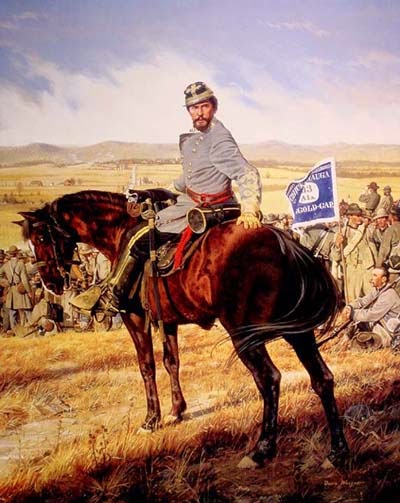
"Cleburne" by David Wright
Partick Cleburne viewing his
troop before the attack
The rest of Cheatham's Corps—Cleburne's and John C. Brown's Divisions—readied to make the frontal assault on the center of the Federal line. Brown's Division followed the west side of the pike while Cleburne's men moved up the right. It would be here in the center that the most vicious fighting would take place, and Cleburne's men would see the worst of it. The army had only two 6-gun batteries. One battery was assigned to each corps, and split up to fill in the gaps between divisions.

At the signal from Winstead Hill at 4:00 PM, the hardened Confederate troops began their fateful march. Brigade bands, which for the first time carried their instruments into battle, struck up "Dixie" and "The Bonnie Blue Flag" as if they were going on parade. It was an amazing spectacle to behold and was forever remembered by participants on both sides. "In the whole history of the war," writes historian Stanley F. Horn, "there never was such an imposing military spectacle as was here presented—eighteen brigades of infantry, with their cavalry support, marching in a straight line across an open field, in full view of their commanding general and of the entrenched enemy." The advancing corps, with banners waving, created a line almost 2 miles wide with a force half again larger than Pickett’s Charge at Gettysburg. But these Confederates had twice as far to march. Considering the enormity of the battle and the slaughter that was to come, it's astounding that the Battle of Franklin is not at least as well known as its eastern counterpart.

Since Schofield's troops at Franklin had not planned on making a stand there (Schofield had been ordered by Gen. George Thomas to abandon Franklin and retire to Brentwood), they were astounded by what they witnessed: Seemingly, the entire Confederate army was approaching. As sunset neared, 22,000 Confederates began their march.

Source: Civil War Maps by Hal Jesperson

Cleburne rode with his advancing line of 3 brigades. He guided his division toward the first Federal defenses, manned by Gen. George D. Wagner's division, using the Columbia turnpike on the left as a guide, and the Carter house as his target. Almost as soon as Cleburne's men came into the open, Federal batteries opened fire, tearing holes in his advancing line. His officers ordered the men to close up and fill the gaps as the advance continued. A few Confederate guns were able to fire above the men and into the enemy soldiers, now only 400 yards away from the advance. It took almost 15 minutes for Cleburne’s leading division to advance the first mile, adjacent to Privet Knob.

At this point, Cleburne halted his brigades and reformed his men into 2 attacking lines. The other divisions did the same. When Cleburne's lines were within a hundred yards of the advanced Federal position, the enemy fired into them, only slowing the determined Confederates momentarily. Raising the Rebel yell, Govan's and Granbury's men charged toward the 2,000 soldiers of Union Col. Joseph Conrad's exposed brigade. Cleburne urged his men forward, and his troops were soon on them in the first breakthrough in the Federal line. A brief hand-to-hand struggle erupted, but the line soon crumbled, and the Federals ran. Scores of the enemy were killed, wounded, or captured as they fled.2 

Cleburne and his troops closely pursued Wagner's broken division, intending to smash them into the main Union works in the rear. But the throng of running soldiers soon became intermingled. Federals behind the main defensive lines were forced to withhold their fire for fear of hitting their own returning troops. Cleburne's men now were aiming for Carter's cotton gin directly ahead on the right (east) side of the road. Cleburne spurred ahead into the mass of men, and was charging diagonally across the front of his own brigades toward the center of the line when his horse was killed. Picking himself up, he was given another. He had only started to mount when this horse also was also shot. He decided to draw his sword instead and lead the charge on foot.


Photo by Mark Dolan, June 2010
View across Cleburne Park to the area of the Cotton Gin (about where the blue
house in the center background sits), scene of some of the fieriest fighting. Thanks
to the Franklin's Charge and the Civil War Trust, the area around the former Cotton
Gin has been reclaimed, and the new Cotton Gin Park will be opened this year on
the sesquicentennial of the Battle of Franklin.

The Federal riflemen and those manning the cannon, had an open field of fire, and by now, the they could hold their fire no longer. Men of both armies were cut down. A wave of Confederates pressed to the enemy's line and halted in the ditch below the earthworks. Undaunted, Cleburne’s Division pursued the fleeing defenders. The unstoppable men seized the 4 guns at the pike about 110 yards from the main line, and gained the outside of the main works east of the cotton gin, killing, wounding, and capturing 250 enemy. In the midst of the melee, Gen. Granbury was struck dead with a bullet to his head.

Cannon shell pyramid near where Cleburne fell
Several hundred of Cleburne’s men surged over the embankments and through the gap left in the defenses at the pike. One of Granbury's or Govan's men planted Cleburne's blue divisional flag atop one of the defensive embankments. East of the pike and within 40 yards south of the enemy's works, a single enemy bullet ended the life of an extraordinary Southern hero. Gen. Cleburne was hit in the chest and killed instantly. “It was the work of but an instant," wrote historian Wiley Sword, "a great chasm in Southern history frozen in microseconds. In one shocking moment Pat Cleburne collapsed to the ground, carrying with him perhaps the best hopes of a dying Confederacy’s western army.”

Lowrey's Brigade, which followed, was now near the cotton gin and the center of the inferno at the gap. Gen. Lowrey, at the head of his brigade, brought his men forward “under the most destructive fire I ever witnessed.” Unaware that their commander had fallen, the rest of Cleburne’s Division continued its momentum on and beyond the main line, facing a force that had just repulsed Stewart’s attack on the right (Stewart assaulted the main line as many as 13 times, but was unable to penetrate). As Cleburne’s men now attacked, they came upon terrible fire from their right. Here the fighting became even more severe. 

Along the line there followed a series of uncoordinated assaults. Brig. Gen. John Adams’s Brigade of Stewart's Corps, approached to within 50 yards of the earthworks, where his men were met with deadly fire. As his brigade attempted to advance the general was killed while trying to jump his horse over the embankment, abut 100 yards east of the pike. Near here, Brig. Gen. Francis M. Cockrell, wounded 3 times, finally was pulled over the works and captured by Yankee soldiers. Brig. Gens. William A. Quarles and Thomas M. Scott were also severely wounded. 

West of the pike, Brown’s Division captured about 150 yards of the main line. Parts of 2 of his brigades went over the breastworks and advanced some distance within the works. However, a Federal countercharge drove them back. The men continued to hold their ground along about 75 yards of the outside of the works until the battle ended. Brig. Gens. States Right Gist was mortally wounded and Otto F. Strahl was killed. Gen. Brown, also was badly wounded. Capt. Tod Carter, whose family's home was within sight, was mortally wounded as well.

Throughout the center of the battlefield the slaughter for both sides was greatest. Gen. Cox wrote that the Federal loss in killed was "trifling everywhere but near the center." Historian Eric Jacobson notes,
The clash was uncommon even in a war that had dragged for nearly four years. At Franklin it was if all sense of morality vanished entirely. A war that had started with pomp and grandeur had spiraled into a bloody and gut-wrenching struggle, where victory could only be achieved by an absolute extermination of one side or the other.
Mobs of men continued to stream up the turnpike and swarm into the Federal defenses. As the first hour of fighting wound down, the killing was far from over. Federal forces on both sides of the turnpike crumbled.

By this time, Federal Gen. Emerson Opdycke, who understood his army's peril, led his brigade in a disorganized counterattack toward the gap in the east side of the pike. Men from Cleburne's and Brown's Divisions slammed into them, resulting in a brutal hand-to-hand fight, a maelstrom that few of the hardened soldiers had ever witnessed. Scattered troops from both sides fired from all directions. Men fought each other to death with anything at hand. “The collision of the 2 mobs amid the Carter house and the outbuildings became a lifelong memory,” wrote historian Wiley Sword. "It was a hand-to-hand combat that witnesses could never describe accurately or portray fully."3 

The Carter office building and smokehouse beyond
By sheer weight of numbers, the Federals began to force their way forward to strengthen the Federal line. But the furious Confederate attack did not stop. Trailing brigades of Cheatham’s Corps continued to arrive and assault the Federals in the Carter garden and around the home. On the north side was the smokehouse and farm office outbuilding, where Opdycke’s and other brigades fought behind the low rail barricade and garden fence. Across the bare garden to the south Confederates returned fire from the main earthworks. Faced with overwhelming numbers, the Confederates eventually were forced to withdraw. In the chaos and choking smoke, Federal soldiers took 394 prisoners, including 19 officers and 9 battle flags.4

Photos by Mark Dolan, June 2010
Bullet holes are still visible in many of the Carter buildings.
Brown’s, Cleburne’s, and some of Stewart’s troops now stubbornly held the outside perimeter of the Federal entrenchments east of the house. Some tried going over the works, but were either shot or pulled over to be made prisoners. Both sides fired blindly over the top or through the space below the head logs. As their ammunition ran out, soldiers were forced to rummage through their fallen comrades for more. Govan later wrote, that when his brigade advanced to the main line of entrenchments, “here commenced the most desperate fight I ever witnessed which lasted until near midnight. Our men occupying one side of the breastworks, the Yankees the other.” About 300 Confederates were forced to surrender, among them Brig. Gen. George W. Gordon who with some of his command had strayed to the right and now were mingled with Granbury's men.

While the desperate struggle around the Carter buildings was taking place, Lowrey's men and other soldiers from Cleburne's command continued to battle Federals on the main line east of the pike to the cotton gin. Gruesome fighting ensued as the Confederates held onto the outside of the embankments all the while receiving horrible crossfire from the cotton gin on their right. To add to their misery and frustration, the earthworks had been constructed so that the Confederates could not fire without exposing more of their bodies than the Federals. Only feet away on the other side of the mound, Union troops took turns firing on their attackers. Those in the rear reloaded and passed their muskets to those on the front of the defenses. Whenever a Confederate raised his head he was immediately shot. There was nothing else they could do but fire blindly back and forth. For those approaching, the smoke was so dense that the enemy’s works couldn’t be seen until only a few yards from them.

Gen. Lowrey's men did everything that was humanly possible to succeed. The enemy which had been driven from the first line was now ensconced behind a second defensive line and held the Confederates in check. "I threw my brigade into the outside ditch of his massive works," wrote Lowrey, "and my men fought the enemy across the parapet." To this point, half of his men were already dead or wounded, "and the balance could not scale the works. It would have been certain death or capture to every one of them." Leading his men on horseback, Lowrey made it to within 30 feet of the works when his horse was wounded.

Although the men fought bravely, nevertheless their assault was doomed. Ultimately, many more men were killed or captured by the time all hope of success had failed them. Lowrey's Brigade, which had suffered the most casualties at Spring Hill the day before, now experienced further decimation. Finally, Lowrey wrote, "When I saw nothing else could be done, I went to the rear, and began the work of gathering up the fragments of our division.”

The Confederates fought well into the night. About 7:00 PM, Hood finally ordered forward one more division, Maj. Gen. Edward Johnson’s of Lee's Corps, to help the center. However, his division also was decimated in a courageous attack. Brigade commander, Arthur M. Manigault, was severely wounded. 

Each side had tried and failed to control the few acres of open ground that had been Carter family’s home and farm. By now, darkness covered the bloodied battleground. While Cleburne’s and Brown’s men had partially carried out their objective and held a portion of the works until the end of the fighting, a stalemate was the best that could be reached at the crucial Carter house hill. Even as darkness enveloped the savage scene, the 2 sides continued to fight stubbornly beyond the point of exhaustion. Finally, near 10 PM, the firing died down, and both sides withdrew.

In this, the bloodiest 5-hours of the war, Hood’s loses were appalling—approximately 7,000 killed and wounded—nearly a third of those he ordered into battle. In addition to the unprecedented loss of 6 generals, a significant number of regimental commanders and other officers were killed or wounded. Sixty-five Confederate commanders of divisions, brigades, or regiments were listed as casualties. Thirteen generals were were injured or captured.

Cleburne’s Division, as it had nobly done so often, sustained the greatest loss of any other—over one-half. The Confederates' losses at the Battle of Franklin all but guaranteed the defeat of the Army of Tennessee at Nashville 16 days later. More importantly for the South, it hastened the doom of the Confederacy.

Photo by Mark Dolan, June 2010
The McGavock Confederate Cemetery

Fourteen men from Great Grandfather Oakes's 32nd Mississippi Infantry Regiment were buried at McGavock Confederate Cemetery on the Carnton Plantation in Franklin. As many as 5 of these were from his company, Co. D. For Great Grandfather Oakes, like thousands of others, the loss hit on a personal level with the death of a close friend. Thirty-five years later, he wrote a short letter to the editor of the Confederate Veteran to commemorate him:
The Confederacy lost one of her bravest when Comrade [Miley] Steele fell dead at Franklin on top of the breastworks to the left of the pike 5 leading from Columbia into the town. He was never heard to murmur or to disobey, and professed great faith in the cause of the South and in the ability of our leaders. Above all, he was a true Christian, having joined the church at Dalton, Ga., a fact which his relatives never knew.

Photo by Mark Dolan, June 2010
The Mississippi Section of the McGavock Confederate Cemetery where
424 of Great Grandfather Nathan Oakes's comrades were laid to rest

According to the historians Purdue, the death of Maj. Gen. Patrick R. Cleburne had a swift effect on the army and soon the Confederate people. Troops could hardly believe that such a calamity had befallen the army. Some of his men visited the Carnton House on the morning of Dec. 1, for a last look at their general. Gen. William Hardee later commented, “The death of Cleburne cast a deep gloom over he army and the country. Eight millions of people, whose hearts had learned to thrill at his name, now mourned his loss, and felt there was none to take his place.”

Photo by Mark Dolan, June 2010
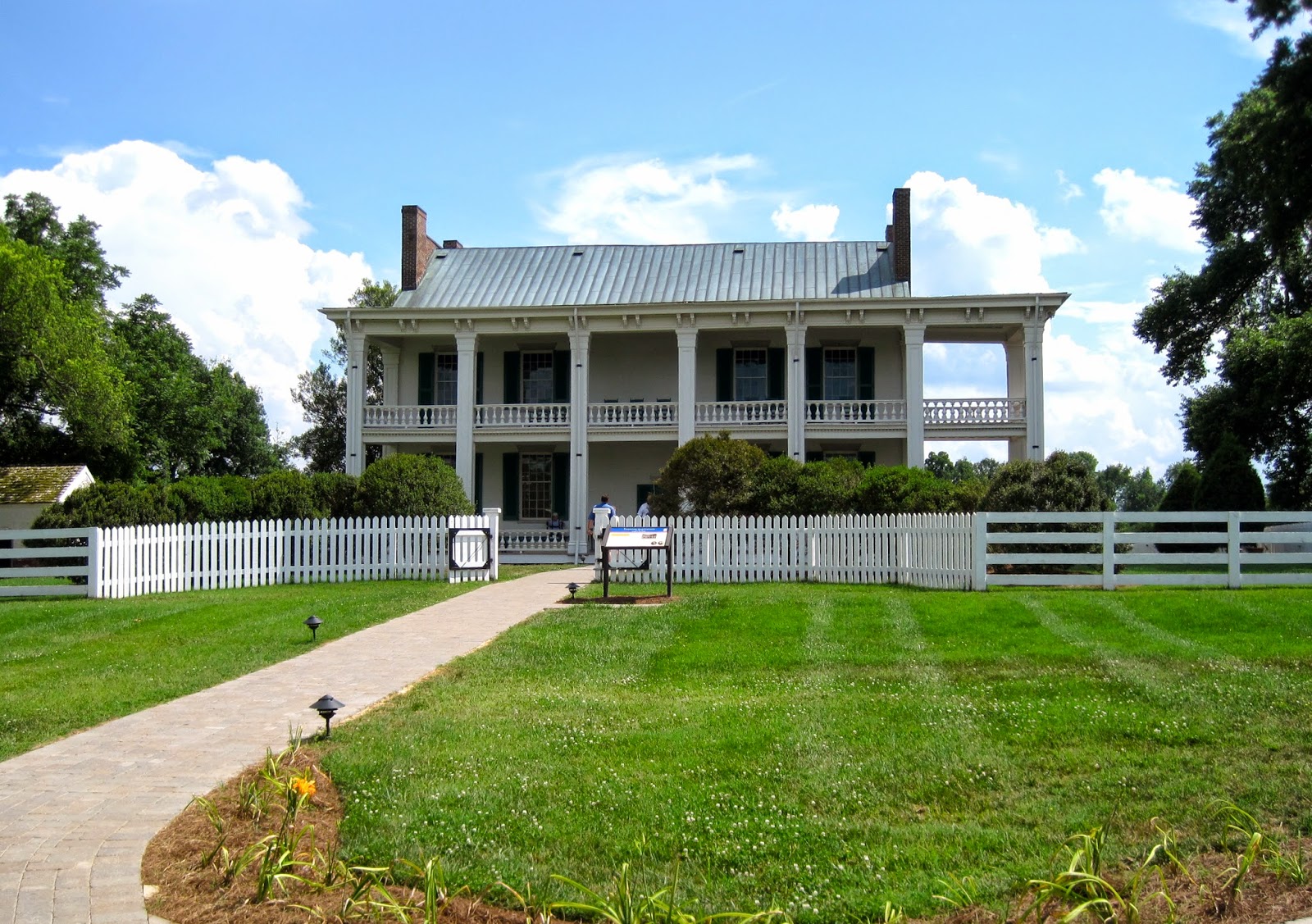
The Carnton Plantation House
After the Battle of Franklin, the bodies of 4 of the 6 slain
Confederate generals were laid for viewing on the lower porch.
Even though Cheatham's, Stewart's, and Stephen D. Lee's Corps had been massacred in the battle, nevertheless, Hood planned to attack again the following morning. Confederate batteries were placed on the high ground at Winstead and Breezy Hills. In their rush in the darkness to get positioned on the heights some of the guns inadvertently were rolled over the dead and wounded. However, by 2 AM, the Federals, leaving their own fallen troops, slipped away under cover of night over the river, burning the bridge behind them. It was just as well. Hood's forces were too decimated to take up another attack. Brigades were left without their generals, regiments without colonels, and other field officers were in too short supply to reorganize the men into anything like a fighting force.

Schofield was amazed at the Confederate attack. His assignment to Cox for the preparation of defensive breastworks had been intended only as a temporary threat to Hood while he evacuated his Federal army. But as it happened, it was Cox's prudent preparations and Opdycke's and other officers' bold actions that saved Schofield’s army from disaster at Franklin.

__________________________________________________________________

'Pickett's charge at Gettysburg' has come to be a synonym for unflinching courage in the raw.
The slaughter-pen at Franklin even more deserves the gory honor.
Stanley F. Horn
________________________________________________________________________

1 Historian Craig L. Symonds concluded that instead of supervising the action at Spring Hill on the 29th, the disabled Hood had retired to his headquarters at the Thompson Mansion for an early dinner and a laudanum-induced sleep. Moreover, there is strong evidence that Hood knew that night that his troops were not holding the Columbia-Franklin turnpike. Both Cheatham and Stewart wrote later that before he went to bed, he was already criticizing the army for its lack of energy, and in particular for its failure to seize the turnpike. Others agree. 
2 Author and Battle of Franklin historian Eric A. Jacobson provides a compelling narrative of the "Breakthrough" and also the bitter fight at the Cotton Gin, in his video available at the Civil War Trust website. When my wife and I visited the Franklin battlefield in 2010, we were introduced to Eric Jacobson at the museum there. He was gracious enough to spend more than an hour discussing the battle and answering my questions. His book about the Battle of Franklin, For Cause & For Country, is one of the best to be published in recent years.
3 Indeed, the fighting almost everywhere beyond the Federal line was vicious and brutal. As an aged veteran, Frank Cheatham, returned to Franklin where he met a Union veteran who seemed uncertain about being in the company of a former enemy of that terrible battlefield. Cheatham embraced him and said reassuringly, “Any man who was in the battle of Franklin, no matter which side, is my friend” (Sword). Another witness to the carnage, Pvt. Sam Watkins, who fought on the left of the pike, describes his impression like this:
Kind reader, right here my pen, and courage, and ability fail me. I shrink from butchery. Would to God I could tear the page from these memoirs and from my own memory. It is the blackest page in the history of the war of the Lost Cause. It was the bloodiest battle of modern times in any war. It was the finishing stroke to the independence of the Southern Confederacy. I was there. I saw it. My flesh trembles, and creeps, and crawls when I think of it today. My heart almost ceases to beat at the horrid recollection. Would to God that I had never witnessed such a scene!
4 In this counterattack, Federal Major Arthur MacArthur of the 24th Wisconsin, hero of the Battle of Missionary Ridge and father of Gen. Douglas MacArthur, was severely wounded.
5 Great Grandfather's reference to soldiers from his division (Patrick Cleburne's) fighting to the left of the turnpike is the only one I know of. All other reports place the 32nd Regiment in the center of the fighting, but to the right of that road. Of course, in the confusion of the battle, it is very possible that solders like Steele and my great grandfather became mingled with other units and were separated from their commands.

Sources: Advance and Retreat, John B. Hood; Stonewall of the West, Craig L. Symonds; Pat Cleburne: Confederate General, Howell & Elizabeth Purdue; For Cause & For Country, Eric A. Jacobson; The Army of Tennessee, Stanley F. Horn; Five Tragic Hours, James Le McDonough & Thomas L. Connelly; Mark P. Lowrey Autobiography; Military Reminiscences of the Civil war, Jacob Dolson Cox; Co. Aytch, Sam Watkins; Confederate Veteran, Vol. 8; Official Records, Vol. 45, Pt. 1

Monday, May 19, 2014

Clash at Cassville, May 18-19, 1864

Withdrawing from his position near Adairsville on May 18, 1864, Confederate Gen. Joseph Johnston moved his Army of Tennessee further south to Cassville. His plan was to deceive Gen. William T. Sherman and destroy a portion of his advancing army.

Source: Civil War Maps by Hal Jesperson
There were 2 roads leading south from Adairsville, one was along the Western and Atlantic Railroad to Kingston and the other to Cassville. Johnston's strategy assumed that Sherman would divide his army in order to use both roads. This would give the Confederates an opportunity to attack one column before the other could come to its aid.

Johnston ordered William Hardee's Corps to move to Kingston as the decoy, while he with Gens. Leonidas Polk's and John B. Hood's Corps fell back toward Cassville. He hoped that Sherman would believe that the larger Confederate force was in Kingston and would, therefore, concentrate his forces there. Hardee was to hold up the Federals at Kingston while Johnston prepared the rest of his army to destroy the other column moving to Cassville.

Maj. Gen. Patrick Cleburne, in whose division my Great Grandfather Nathan Oakes was serving, wrote in his report that his division was the last of Hardee's to withdraw from the battle line at Adairsville in the early hours of May 18th. Leaving skirmishers behind to cover their withdrawal, and moving in a dense fog, his division followed Hardee's Corps down the road to Kingston. At this point there was nothing between Cleburne's men and the pursuing enemy.

Cleburne's Division reached Kingston later that morning, where he rested his men for several hours. As per Johnston's plan, on today's date, he then marched 3 of his brigades, including Great Grandfather's (Lowrey's Brigade), to Cassville, arriving there by mid-afternoon. He left Lucius Polk's Brigade in Kingston as a rear guard to hold the enemy in check, which would follow later.

Gen. Johnston had guessed correctly. When Sherman arrived on site at Adairsville, he wrongly interpreted the tracks he saw as those of Johnston's whole army on its way to Kingston. This confirmed to him his decision for sending Gen. James McPherson's and most of Gen. George H. Thomas's army to Kingston. He ordered only Gen. John Schofield's and a single corps of Thomas's army to Cassville.

Earlier in the morning of the 18th, McPherson and his corps, which was camped 4 miles northwest of Kingston, began the march to that town, ready for battle with the Confederates there. At the same time, Thomas's army, accompanied by Sherman, was 3.5 miles north of Kingston, and was also moving on the town. When the generals converged on Kingston they were surprised to find that the Confederate army was not there, but instead was 5.5 miles away at Cassville.

The morning of today's date brought an opportunity for a Confederate offensive. Federal Gen. Joseph Hooker's corps was marching on the road to Cassville, looking to find the railroad between Kingston and Cassville and to ultimately hook up with Thomas on his right. At the same time, Johnston, who thought that Sherman must have learned by now the location of his Confederate army, did not know that Sherman was still in the dark, and therefore concluded that Sherman was heading to Cassville.

The aggressive Gen. Hood volunteered his corps for an immediate attack on the Federal column heading in his direction. Hood marched his men along a country road a mile or so east of the Cassville road and formed them facing west to strike the enemy's left flank. At the same time, Polk's Corps would attack the head of the column. The Confederate's position for this attack was a good one. However, as Hood was moving into position, he encountered Federal soldiers to the east, which he feared would attack his corps's exposed flank and rear. So after only a brief skirmish, Hood fell back, and the Confederate advantage was lost. Johnston, understanding that it was too late to regroup and resume the offensive, ordered Hood and Polk to move to a new line east and south of Cassville, where they would be joined by Hardee's Corps, now pulling back from Kingston. Here he believed the army could make its stand.

By the afternoon, Johnston had arranged his army to deliver a fight from a wooded ridge below Cassville. It was a strong position from which to offer battle to Sherman. He placed Hood's Corps on the right. Polk's army was placed in the center across the Adairsville road. He positioned Hardee on the left to cover the route from Kingston, with Cleburne's Division across the rail line before it passes Cass Station.

In the meantime, not finding Johnston at Kingston and assuming he was retreating further south, Sherman ordered Thomas to move his column east on the Cassville road to join Hooker and Schofield. As Thomas pushed towards Cassville in the afternoon, he met advanced units from Hardee's Corps in his path. He mistakenly interpreted this Confederate force as a single division, and reported such to Sherman. Thomas was unaware that he had run into the whole Confederate army. 

At this point, the situation for Johnston looked promising. He had the defensive advantage, and his army had now been strengthened to over 70,000 troops, the largest force the Army of Tennessee would ever see again. Perhaps best of all for Johnston, Sherman had fallen for his ruse.

In the late afternoon, Sherman arrived on the scene and ordered a bombardment of the Confederate line to provide cover for the advance of his infantry, which he planned to use in an attack in the morning.

While nightfall brought an end to the cannonade, the attack demonstrated to the Confederates that the enemy could effectively enfilade their position. Alarmed by the effectiveness of the artillery against them, Hood and Polk went to inform Johnston. They insisted that their positions were too vulnerable to defend. Hardee was of a different opinion, but he could not convince his fellow generals to change their minds. So, in the end, Johnston gave in and ordered a retreat through Cartersville across the Etowah River. In his own memoirs, Johnston later wrote that he never ceased to regret the decision.*

Between midnight and 2 AM on the 20th, the disappointed Confederates pulled out of their works and marched across the Etowah River toward Allatoona, 8 miles to the rear. Cleburne's Division crossed over a bridge near the railroad crossing. On the heights about 3 miles south of the river and 2 miles east of Allatoona, his division along with the rest of Hardee's Corps, stopped to guard the army's withdrawal. They remained there for several days before marching on to Dallas.

The decision at Cassville was a frustrating disappointment to most of the rest of Johnston's officers and men who had been led to believe that they were done with retreating.

                     ______________________________________________________


The original town of Cassville founded in 1833, is no more, having been destroyed by Sherman's cavalry in November 1864. Only a simple stone cenotaph with a commemorative iron plaque marks its location. However, in 1899, the Cassville Chapter of the United Daughters of the Confederacy honored the 300 or so unknown Confederate soldiers who died of wounds or disease in hospitals located in Cassville. The hospitals operated from late 1861 until they were evacuated with Johnston's retreating army. One of the markers from 1899 in the cemetery has this inscription:
So long as breathes a Southern woman, so long as time shall last, so long will Southern women cherish and honor the memory of the Confederate soldier and meet annually to strew their resting place with choicest garlands.


Photos by Mark Dolan, June 2010

* Even Johnston's opponents recognized this fact. Union general, Maj. Gen. Jacob B. Cox, wrote in his memoirs, "The order to fight had been published, and even a defeat might be less mischievous than the sudden retreat in the night without joining the battle which had been so formally announced. Either the order had been an error or the retreat was one. Every soldier in the army knew this, and the morale of the whole was necessarily affected by it."

Sources: Pat Cleburne: Confederate General, Howell & Elizabeth Purdue; The Army of Tennessee, Stanley F. Horn; Decision in the West: The Atlanta Campaign of 1864, Albert Castel; Military Reminiscences of the Civil War, Jacob Dolson Cox; Narrative of Military Operations During the Civil War, Joseph E. Johnston; Official Records, Vol. 38, Pts. 3 & 4

Friday, May 16, 2014

Skirmishing at Calhoun

Having been forced to withdraw from Resaca, Confederate Gen. Joseph Johnston positioned his Army of Tennessee at Calhoun on this date in 1864.

Late the night of the 15th, Gen. Patrick Cleburne had withdrawn his division from Resaca. With Cleburne's Division, Great Grandfather Nathan Oakes crossed the Oostenaula River, halting with the army north of Calhoun. On the morning of today's date, Cleburne formed his men in a defensive line of battle along the road to the town before being ordered to face a Federal force seeking a way through or around it. Joining Walker's and Bate's Divisions, his Confederates formed the rear guard and skirmished with the enemy while the main of the army rested for a few hours. Great Grandfather's 32nd Regiment was posted on a hill, supporting the artillery.

Source: Historic Markers Across Georgia

Since Calhoun did not offer an acceptable defensive position, Johnston planned instead to make a stand 8 miles south, just north of Adairsville, in the valley formed by the Oothcalooga River. He moved the army in the early hours of the 17th, while his cavalry under the command of Gen. Joseph Wheeler, fought a skillful rearguard action south of town.

Sources: Pat Cleburne: Confederate General, Howell & Elizabeth Purdue; Autumn of Glory, Thomas Lawrence Connelly; Military History of Mississippi, 1803-1898, Dunbar Rowland; Official Records, Vol. 38, Pt. 3

Tuesday, May 13, 2014

Cleburne's Division at the Battle of Resaca, 1864

When Gen. William T. Sherman's 100,000-man Union force flanked him at Rocky Face Ridge, Confederate, Gen. Joseph E. Johnston was forced to withdraw his Army of Tennessee to the hills around Resaca, Georgia. Here he will make a stand in the Battle of Recaca, fought on May 13-15, 1864.

Photo by Mark Dolan, June 2010
WPA map of the Battle of Resaca, May 13-15, 1864*
Gen. Patrick Cleburne marched his division (in which Great Grandfather Nathan Oakes was serving in the 32nd Mississippi) with William J. Hardee's Corps to the ridge above Camp Creek Valley where his men built rifle pits to defend against the advancing enemy. Har-dee's Corps was in the center of the line, Polk's Corps was on the left, and Hood's Corps was placed on on the right, extending across the rail line to the Conasauga River. Johnston intended to defend Resaca in the hopes that Sherman will make a costly frontal assault or leave himself open to a counterstrike.

For his part, Sherman is under the impression that Johnston is merely stalling to gain time to retreat further south across the Ostanaula River. With that in mind, Sherman ordered a pontoon bridge to be assembled across the river at Lay's Ferry, which he planed to use in order to cut of Johnston's retreat. In the meantime, he will try to keep Johnston's army in place.

Soon on the 13th, Federal soldiers began skirmishing with the Confederates, probing the army's strength. Full-scale fighting commenced early the following morning. Sherman ordered the attacked  to begin on what he assumed to be the Confederate right. Due to the difficult terrain Sherman's assault accomplished little, and by mid-afternoon it ground to a halt with significant losses. Changing strategies, he he ordered an artillery bombardment of the Confederate position.

Cleburne reported that during the afternoon, "the enemy made several attempts to charge, but uniformly they were unhappy failures." In this afternoon struggle, Cleburne's sharpshooters had the major role. They repeatedly silenced the Union batteries firing from 800 yards away, and also destroyed a line of Federal skirmishers. On Hood's front, his men made a successful charge before darkness brought it to a halt. Union troops were generally repulsed along the line.

On the 15th, the battle continued with no advantage to either side. Sherman was learning that direct assaults were too costly, so he attempted a tactic that worked for him at Rocky Face Ridge, and one he will employ throughout the Atlanta Campaign: He ordered a flanking movement. Having numerical superiority of nearly 2 to 1, he was able to leave a large force at Resaca to threaten Johnston's front while using his right wing to turn the Confederate left. He also sent a force over the Oostanula River behind Johnston and towards his railroad lifeline to Atlanta.

Photo by Mark Dolan, June 2010
Cemetery at Resaca, final resting place for some 400 Confederate fallen,
many of whom are unknown

Unable to halt this Union turning movement, Johnston employed one of his own tactics that he will use often in the campaign: Defend a position until the advantage is lost, then withdraw to fight again. Because Johnston did not have sufficient forces both to hold the Resaca position and men enough to detach for the threat to his rear, he was forced to retire. For the second time Johnston has escaped disaster, but also has abandoned another strategically strong defensive position, thus permitting Sherman to push further towards Atlanta.

The battle's outcome was indecisive. For its part, the 32nd Mississippi Regiment suffered 5 killed and 7 wounded. As a whole the army received 2,800 casualties to a Union loss of over 4,000.

Photo by Mark Dolan, June 2010
Late in the evening of the 15th, Cleburne withdrew his division with the rest of the corps under the protection of skirmishers left behind for cover. They crossed the Ostenaula River over a trestle bridge, and marched to within a few miles of Calhoun. The battle for Cleburne's men at Recaca had been relatively light. That will change almost immediately, and in the weeks ahead, his men will be called upon to defend the army in near ceaseless fighting.

Johnston will rest his army at Calhoun before marching them on the 17th to a new defensive position at Adairsville.


* An excellent map of the battle is available at the Civil War Trust website.

Sources: Pat Cleburne: Confederate General, Howell & Elizabeth Purdue; Stonewall of the West, Craig L. Symonds; The Army of Tennessee, Stanley F. Horn; Decision in the West: The Atlanta Campaign of 1864, Albert Castel; A Different Valor: Joseph E. Johnston, Gilbert Govan & James Livingwood; Military History of Mississippi, 1803-1898, Dunbar Rowland; Official Records, Vol. 38, Pt. 3

Monday, May 12, 2014

Prepositioning for the Battle of Resaca

Having his plans for the defense of Dalton spoiled by Gen. William T. Sherman's attacks over the previous days along Rocky Face Ridge, and the enemy's movement around him, Confederate Gen. Joseph Johnston was forced to give up his strong position and begin falling back to Resaca. On the morning of May 11, 1864, Maj. Gen. Patrick Cleburne, in whose division Great Grandfather Nathan Oakes was serving, marched his men from Dug Gap on the Sugar Valley road to a new position 10 miles south, near Resaca. There Cleburne ordered his men, now the rear guard of the army, to build breastworks to defend against the enemy advancing in his direction.

Early morning on today's date in 1864, Cleburne's pickets were driven in by advancing Federal soldiers. His men reported a strong enemy division nearby. Cleburne prepared his man for the anticipated attack. However, the cavalry force opposing him chose to avoid a confrontation.

By now, Sherman had fortified Villanow and was massing his Federal troops in Snake Creek Gap. By noon, Sherman and most of his army had passed through the gap and were skirmishing with the Confederate rear guard along the small Camp Creek. In the meantime, Cleburne collected reconnaissance about the enemy and passed on the information.

Cleburne's men were able to hold up Sherman's advance until the remainder of Johnston's troops arrived at Resaca from Dalton.

Having planned to make a stand at Resaca, Johnston formed his army along a ridge west of town facing Gen. William T. Sherman's approaching army.

Sources: Pat Cleburne: Confederate General, Howell & Elizabeth Purdue; Stonewall of the West, Craig L. Symonds; Official Records, Vol. 38, Pt. 3

Wednesday, May 7, 2014

Cleburne's Division at the Battle of Rocky Face Ridge, 1864

William T. Sherman's Atlanta Campaign of 1864 kicks off with an attack on
Joseph E. Johnston's Army of Tennessee at Rocky Face Ridge/Dalton, GA.
SSource: Civil War Maps by Hal Jesperson
By May 5, 1864,1 Confed-erate Gen. Joseph E. Johnston was alerted to a Federal force moving on his Army of Tennessee en-trenched around Dalton, Georgia. He, therefore, ar-ranged his army to meet the enemy, now under the com-mand of Gen. William T. Sherman.

Johnston formed his main infantry line across Mill Creek Gap, known locally as Buzzard Roost Pass, and from there north for about a mile on the crest of Rocky Face Ridge. His line then continued across Crow Valley. He placed Patrick R. Cleburne's Division north, in front of Dalton, behind Mill Creek Gap. Great Grandfather Nathan Oakes was serving in the 32nd Mississippi Regiment, which was commanded by Col. William H.H. Tison, in Mark P. Lowrey's Brigade of Cleburne's Division.

On today's date, a Saturday in 1864, forces under Gen. George H. Thomas took Tunnel Hill, opening the Battle of Rocky Face Ridge, May 7-13. The next day, his troops attacked Johnston's main line where they encountered well entrenched Confederate forces. Although outnumbering the Rebels here 10 to 1, they were turned back. Surprised by the defeat of his larger force Thomas decided to probe the line further north, near Buzzard Roost, defended in part by Cleburne's Division, while Gen. James McPherson moved his army south in the direction of Resaca in an attempt to outflank the Confederate's position. Thomas ordered 5 five full-scale attacks against the defenders at Mill Creek Gap, but ultimately met with defeat.


Mill Creek Gap/Buzzard Roost Pass, Georgia, 1864
From the Matthew Brady Collection

Elsewhere on the line, Union Gen. John Schofield was moving his army south from Red Clay, when he was attacked by Confederate Gen. Joseph Wheeler's cavalry. While Thomas was moving his attack further north to Buzzard Roost, Schofield skirmished with Wheeler's men. On the 9th, Wheeler attacked a portion of Shoffield's cavalry force at Prater's Mill and delivered Sherman his first defeat of the campaign.

In the late afternoon of the 8th, an urgent situation for the Confederates developed at Dug Gap—it was under attack. Dug Gap was a vital pass through the Rocky Face Ridge, 5 miles southwest of Dalton. Its defense was critical. Part of Cleburne's Division was ordered from Mill Creek Gap to reinforce Dug Gap, defended by only 2 small regiments of dismounted cavalry. Cleburne led Lowrey's and Hiram Granbury's Brigades in a rapid march in extreme heat up the steep ridge, arriving at the gap around sundown. While the attack was continuing, Cleburne arranged his brigades to relieve the defenders, which were struggling to hold their position. For a while, the Federals shelled the ridge, but as night fell, the enemy withdrew, leaving behind many of its dead and wounded along with many small arms. Historian Albert Castel notes about the action of Cleburne's men at Dug Gap: "The fight—the first real one of the campaign—is over, and what could have been, against less resolute resistance, a calamitous Union breakthrough has turned out to be a one-sided Confederate victory."

Fighting at Dug Gap, sketched by A.R. Waud
Source: The Civil War Trust

Federal success was to come elsewhere on the battle line. Earlier, on the morning of the 8th, Gen. James B. McPherson's army had crossed Taylor's Ridge at Ship's and Gordon's Springs Gaps, then marched through Villanow and took the important Snake Creek Gap—a narrow 4-mile gorge through the ridge—with little opposition.2 On the 9th, his army passed through the gap to within a mile of Resaca, threatening the railroad there. If he could take control of the town and the railroad, Sherman would have the Confederates trapped between enemy forces in the north and south.

To counter McPherson's surprise move, in the early hours of the 10th, Cleburne with Lowrey's and Granbury's Regiments, along with and 2 other divisions, were ordered toward Resaca. But, while waiting near the town, Cleburne received orders to return to Dug Gap due to a change in the enemy's movements. Fearful of being cut off from the rest of the Federal army, the nervous McPherson turned back. While he had managed to secure Snake Creek Gap, which provided the opening through the ridge Sherman needed, his undue caution ultimately allowed Johnston to escape down the rail line, thus ensuring another confrontation on May 13-15.

Despite McPherson's decision to pull back, together with the Federal repulse at Dug Gap and other points along the Confederate line, Sherman's attacks had managed to upset the Confederate plan to defend Dalton. Johnston was compelled to withdraw.

Leaving Thomas to attack the the main Confederate line on the 10th, Sherman moved the rest of his army south. Thomas's demonstrations were weak against the Confederates that had resisted several earlier frontal assaults over the previous 2 days. But they did give the rest of Sherman's force time to advance along the west side of Taylor Ridge undetected by Johnston's army.

On the11th, Gen. Leonidas Polk arrived at Dalton from Rome, Georgia, with a force of 15,000, bringing up the strength of the Army of Tennessee to nearly 65,000 men. However, with a superior enemy force now in his rear, Johnston withdrew on the 12th, and fell back to Resaca.

Thus began Sherman's Atlanta Campaign of 1864.

1 On the same date, Gen. Ulysses S. Grant launched his simultaneous Overland Campaign against Gen. Robert E. Lee's army in the Battle of the Wilderness. While both armies suffered heavy casualties, on May 7, it was Grant who disengaged and moved southeast for another battle at Spotsylvania on May 8.
2 Gen. Wheeler was assigned to defend Snake Creek Gap with his cavalry. However, on May 7, he removed his pickets for fighting to the north. Failing to maintain reconnaissance in this area of Taylor's Ridge left the Confederates unprepared for the Federal advance. Of course, Johnston should have understood the importance of defending the gap with a sufficient force to hold it.

Sources: Pat Cleburne: Confederate General, Howell & Elizabeth Purdue; The Army of Tennessee, Stanley F. Horn; Autumn of Glory, Thomas Lawrence Connelly; Decision in the West: The Atlanta Campaign of 1864, Albert Castel; Military Reminiscences of the Civil War, Jacob Dolson Cox; Official Records, Vol. 38, Pt. 3