In honor of Pvt. Nathan R. Oakes, CSA

150 years ago, my great grandfather, Nathan Richardson Oakes, served as a private in Company D of the distinguished 32nd Mississippi Infantry Regiment in the Army of Tennessee. He participated in the great Civil War campaigns, including the battles of Perryville, Murfreesboro, Chickamauga, Atlanta, Franklin, Nashville, and Bentonville. I am writing about his engagements as well as some details about fighting for the Lost Cause. I hope to honor him and commemorate the events and individuals that contributed to making this a renowned unit in the Confederate Army of Tennessee.

Showing posts with label Joseph Hooker. Show all posts

Saturday, November 30, 2013

Ringgold Destroyed

On November 27, 1863, Maj. Gen. Patrick R. Cleburne's defense of Ringgold Gap, Georgia, had been a complete success. His division, tasked with holding the gap at all costs while Gen. Braxton Bragg's Army of Tennessee retreated beyond to Dalton, defeated Maj. Gen. Joseph Hooker's army of superior strength and numbers.

On today's date in 1863, Hooker withdrew the last of his occupation force from the town of Ringgold, but not before destroying it. On the previous day, its citizens had been herded outside of town and informed that their village would be destroyed as a military necessity. Overnight, Federal soldiers systematically set fire to the buildings and homes, an terrorist tactic that the Union army will use to maximum effect in the months ahead. The entire town—home to more than 2,000 people—was completely and needlessly reduced to ashes.

Source: Mountains Touched With Fire, Wiley Sword

Wednesday, November 27, 2013

"The most glorious triumph" | Cleburne's Division in the Battle of Ringgold Gap, 1863

Photo by Mark Dolan, June 2010

Following the unexpected victory at Missionary Ridge on the evening of the 25th, Union Gen. U.S. Grant's attention turned towards how to send relief to Maj. Gen. Ambrose Burnside, supposedly under siege at Knoxville. Consequently, he let slip the opportunity to do serious damage to Braxton Bragg's fleeing and disorganized army. Although some pursuit was attempted right after the Confederates fled, it was turned back largely by Patrick Cleburne's command. The hesitation afforded Bragg's army a slim margin of time to make its escape the next day southeast to the town of Ringgold, with Dalton, Georgia as its final destination.

Finally, on the 26th, Grant ordered part of his army to Knoxville and directed Sherman and Thomas to send a force to pursue Bragg. On the same day Bragg was pushing the remnants of his army through Ringgold Gap. Feeling vulnerable about a Federal attack, he ordered Cleburne's Division to again hold off the pursuers until the army had safely retreated to Dalton.

After serving as the rear guard for Bragg's army retreating from the disaster on Missionary Ridge late on the night of the 26th, Maj. Gen. Patrick R. Cleburne ordered his men to bivouac on the South Chickamauga across from Ringgold, a small North Georgian town 20 miles southeast of Chattanooga on the Western & Atlantic Railroad. Serving in Cleburne's Division is Great Grandfather Nathan Oakes, in Company D1 of the 32nd Mississippi Infantry, commanded by Col. William H.H. Tison. Gen. Joseph Hooker's force encamped for the night about 2 miles northwest,.

Maj. Gen. Patrick R. Cleburne
At 3 AM on today's date, a Friday in 1863, Cleburne received Bragg's order to hold Ringgold Gap at all costs. There were only 4,157 men and 2 cannons in Cleburne's Division to hold back an overwhelming number of Federal troops. Initially, his Confederates will have to face 3 of Hooker's divisions, numbering nearly 9,000. More will arrive, swelling the Federal force to 16,000. Just like at Tunnel Hill on Missionary Ridge, the odds are again heavily stacked against Cleburne's men.

Shortly after receiving his instructions, Cleburne ordered his men to wade the stinging cold, waist-high South Chickamauga Creek. Volunteers had been sent ahead to light campfires on the opposite bank so the soldiers could warm and partially dry themselves before being deployed to defend the gap. Cleburne had already crossed the creek ahead of his men to make a quick examination of the ground he was ordered to defend.

Ringgold Gap was a steep, narrow, half-mile pass through Taylor's Ridge (known as Taylor Ridge today), about 400 feet high at its crest. The gap in the ridge was barely wide enough to accommodate the creek along with a wagon road and rail line close by. On the opposite, north side of the gap was White Oak Mountain, which rose 350 feet behind the town of Ringgold. The western slopes of both heights were steep and lightly forested. At the gap's western opening, which Cleburne's men would have to defend, the troops had an open field of fire. However, the ground behind them, on the eastern side of the gap was cut 3 times by the meandering stream. In a retreat, his men would have to cross several bridges or ford the creek to make their escape. It was a dangerous position to be caught in.

Source: The Wild Geese
At around 7:00 AM, in a brilliant display of generalship, Cleburne quickly began positioning his troops on or behind every natural defense where they would be the most effective to hinder an attack. He posted most of his troops on and between the 2 ridges guarding the gap with the majority of them along the stretch of White Oak Mountain extending north. He placed 1 of Brig. Gen. Mark Lowrey's regiments, the 16th Alabama, on Taylor's Ridge to guard the division's left flank. The other 3 regiments, he placed in reserve in Ringgold Gap itself. Great Grandfather Nathan Oakes was posted here with his 32nd Mississippi Regiment (32nd/45th Consolidated). Because the pass was narrow, Cleburne was able to place his regiments in 4 short rows of defense. He had scant artillery, only 2 Napoleon cannons under the command of Lt. Richard W. Goldthwaite, which had to be used in the most effective spot. So, he camouflaged them and placed them in the center, within the mouth of the gap, where they could do the most damage. Cleburne remained here with the cannon to direct the coming fight.

Just a half-hour later, the leading edge of Gen. Hooker's column was spotted across the Chickamauga a short distance away. His skirmishers drove the Confederate cavalry2 at the crossing. Cleburne had planned a ruse to give the impression that only a small force guarded the gap. Fooled into thinking that the Confederate force at the gap was weak and demoralized, almost immediately Hooker ordered a direct attack, even before the rest of his force, including his artillery, had come into position to support it. So far, Cleburne's plan was working, but his men still had to receive the full weight of the approaching Federal attack.

The Confederate army's train of wagons was still in full view, struggling to pass over the winding creek through and beyond the gap toward Dalton, as Hooker's force approached the town. Cleburne's men were the only barrier between the tail of the Army of Tennessee and the pursuing Federal army.

Just after 8:00 AM, not knowing the Confederate force that faced him, Hooker moved his skirmishers forward across an open field to the trees at the foot of the White Oak Mountain. There they were surprised by Confederate skirmishers of Hiram Granbury's Brigade. Granbury's men held their fire until the attackers were within 50 yards, well within killing range. The troops concentrated their fire from concealed positions at the timberline of the mountain. As the Federals recovered they began to climb the steep ridge, only to be stopped by a Confederate unit under Maj. William A. Taylor who led a charge down the slope. The Federals were sent back in confusion towards the protection of Hooker's headquarters at the Stone Depot.

From the Stone Depot, the Federal command reacted by feeding more regiments into the fight. One regiment was sent out over the same ground to attack the Confederate right flank, while another attacked the south slope of White Oak Mountain at the gap. They didn't know it yet, but these troops were heading into Goldthwaite's concealed artillery. Once the Union line was within 150 yards—grape shot canister range—the Confederates opened fire. The right of the Federal line was shredded, and the survivors were sent running for shelter behind the railroad embankment where their fire was largely ineffective.

Photo by Mark Dolan, June 2010
Restored "Stone Depot" | Western & Atlantic RR Station at Ringgold. Hooker's
headquarters and the position from which he sent his troops forward to assault
the Confederate held ridge and gap beyond. View is from the Confederate side.

Farther to the Federal left, soldiers began moving north up the ridge of White Oak Mountain to seek a way around the Confederates' right. Earlier that morning, Cleburne had ordered Brig. Gen. Lucius Polk to form his brigade in the gap along the road running to the rear and to maintain contact with Granbury's force on the ridge. Polk's Brigade fought with the Federal skirmishers who had ascended nearly to the top of the ridge, and after a half-hour of skirmishing, the Federals were driven back. However, the attackers reformed, and being heavily reinforced, began to move back up the crest.

Seeing those Union forces moving to his right, Cleburne ordered Brig. Gen. Mark P. Lowrey to move his command, including Great Grandfather's 32nd/45th Mississippi, from its position in the gap to the top of the ridge in order to hold the Confederate right. According to Cleburne:
I ordered General Lowrey to move his command up the hill and assist General Polk in defending that position. Moving rapidly ahead of his command General Lowrey found the First Arkansas again heavily engaged, but heroically holding its ground against great odds.  Assuring the regiment that support was at hand, he brought up the Thirty-second and Forty-fifth Mississippi in double time, and threw them into the fight at the critical moment. The enemy gave way and went down the ridge in great confusion. Lowrey now brought up the two remaining regiments of his brigade and Polk up the two other regiments of his command. The enemy, constantly re-enforcing, made another powerful effort to crown the ridge still farther to the right.
Lowrey had galloped off ahead of his troops and reassured Polk's men that help was coming up the ridge right behind him. Then he hurried back to speed his brigade along, feeding each of his companies into line as they arrived. In his report, Gen. Lowery wrote of the action:
I moved my brigade at once by the right flank, and after ascending the hill I heard firing several hundred yards to the right, and, leaving a staff officer to bring up the command, I went in haste to see what it meant. I found the First Arkansas Regiment engaging the enemy´s skirmishers, who had already gained the top of the hill. After assuring this regiment that support was at hand, and directing them to hold their position, I hastened to the head of my brigade, which was coming up the ridge at a double-quick with the right flank to the enemy, and the bullets from the enemy's guns already flying down the line, I knew that nothing but the most prompt and rapid movement could save the position, and that I could not take time to put the whole brigade in position before moving upon the enemy. Hence, on reaching the head of the column, composed of Hawkins' sharpshooters and the Thirty-second and Forty-fifth Mississippi Regiments, I commanded, by company into line, and deployed the column on the tenth company, continuing the movement to the front with all possible rapidity at the same time. I sent Lieutenant Hall, my aide-de-camp, to bring up the next regiment in the same manner, and I went with the first to their important work, and nobly did they perform it. Our spirited fire, the sight of re-enforcements, and a terrific rebel yell combined to strike terror to the foe, and he fled in confusion.
By now the opposing lines were only 100 feet apart. Col. Aaron. B. Hardcastle, leading Great Grandfather's 32nd/45th Mississippi, described his regiment's arrival:
On arriving on the top of the ridge, Brigadier-General Lowrey gave the command, "by company into line," and then, "on the tenth company deploy column, and move rapidly forward, obliquing [sic] to the right, and take position on the crest of the ridge to the front," which movements were executed rapidly, and under a hot fire of the enemy at short range, and, from the fatigue occasioned by the toilsome ascent of the steep ridge, some little confusion occurred, and the four right companies formed on the right and the remainder of the regiment on the left of the First Arkansas Regiment, which was in position on the ridge The enemy were near gaining the tip of the ridge when we arrived and drove them back in disorder and confusion, inflicting a heavy loss on the enemy.
Other Federal regiments were sent to support the troops struggling on the ridge, some coming within a few yards of reaching the summit. In order to counter this new threat, Polk and Lowrey shifted their forces to the right. Col. Hardcastle's report continues:
In about three-quarters of an hour the First Arkansas Regiment moved to the right, and I then formed my left on the right wing, and reformed my regiment in good order while subject to a heavy fire from the enemy.
Observing that the Federal forces continued to move to the Confederates' right flank, Polk moved his defending regiments to the threatened position and sent orders for the 5th Confederate Regiment to move to the top of the ridge. In his report, Gen. Polk stated:
After a considerable delay, about 12 m., the enemy commenced moving a column rapidly by the left flank on a road running some 200 yards from the foot of the ridge. I again moved by the right flank and watched their movements. Having moved by the left flank some half mile, the enemy by a rapid movement threw their line in a column of regiments and advanced up the hill. They were again met by the same stubborn resistance that before repulsed them. General Lowrey coming to my assistance with one of his regiments, I had it moved in rear of my line until the enemy had advanced within 40 yards of my line, when I ordered it up in line with First Arkansas Regiment, and at the same time throwing Second Tennessee down the hill upon the left flank of the enemy, they were again driven back to the foot of the hill in great confusion.
The Confederates on the ridge made excellent use of the terrain to deliver enfilading fire into the ranks of the advancing Yankee regiments. Gen. Lowrey reported:
The Thirty-third Alabama Regiment was soon brought up and formed on the left of the Thirty-second and Forty-fifth Mississippi, and the Forty-fifth Alabama on their left, while Brigadier-General Polk came up with two regiments and formed them on the right. The enemy, in the meantime, was pressing up the hill with great, determination, but the heavy fire from our advantageous position rendered their ascent impossible. But as they continued to move to the right, it was necessary for our line also to move to the right and to leave a bare line of skirmishers to hold the crest of the hill on the left. When Brigadier-General Polk was severely pressed, he sent to me in great haste for assistance, when I moved the Forty-fifth Alabama Regiment in double-quick to his support, and the general said as his ammunition was nearly exhausted they were just in time to save the position. When my ammunition was nearly exhausted and I had sent for more, my men and officers gave me assurance with great enthusiasm that they would hold the position at the point of the bayonet and with clubbed muskets if the enemy dared to charge them. The position was held until I was ordered to retire from it, which was done in good order.
It was a fight at close quarters. At one point, men fought with pistols and even resorted to hurling rocks. Gen. Cleburne credits the rocks thrown by the men as having actually knocked down attackers resulting in their capture. In his official report, Cleburne sums up Polk's and Lowrey's defense of the ridge in the Federals' second attempt to take it:
A peculiarity of Taylors Ridge is the wavy conformation of its north side. The enemy, moving up in a long line of battle, suddenly concentrated opposite one of the depressions in this wavy surface and rushed up it in heavy column. General Polk, with the assistance of General Lowrey, as quickly concentrated a double line opposite this point, at the same time placing the Second Tennessee in such a position as to command the flank of any force emerging from it. The attack was again defeated and the enemy hurled down the hill, with the loss of many killed on the spot, several prisoners, and the colors of the Seventy-sixth Ohio Regiment. The colors and most of the prisoners were captured by the First Arkansas.
Years after the war, Lowrey wrote about this critical phase of the struggle at Ringgold Gap:
Brig. Gen. Mark P. Lowrey
The victory was ours and the enemy was gone down the hill in perfect confusion. A deafening shout of triumph went through our line, and General Polk, as if enwrapped in the glory of our success dashed up to me, and seizing me by the hand exclaimed, "Just in time to save us, General!" The men, observing the rapture of their brigade commanders, again pierced the heavens with their shouts of triumph, greatly to the annoyance, no doubt, of the discomfited columns of the enemy.

Lowrey went on call the defense at Ringgold Gap "the most glorious triumph I ever witnessed on a battle field." Due to his role on this date, perhaps he should be allowed a little poetic license. Certainly, the division deserved the same high praise for its triumph at Tunnel Hill only 2 days before, when the odds against it were nearly twice as high.
Author Peter Cozzens writes of Lowrey and Polk, "Seldom, in fact, was a unit commander in the Army of Tennessee better served by his subordinates than was Cleburne at Ringgold Gap." Cleburne reported, "To Brigadier-Generals Polk and Lowrey and Colonels Govan and Granbury, I must return my thanks. Four better officers are not in the service of the Confederacy." 

Maj. Gen. Joseph Hooker
During the 2 hours that Polk and Lowrey were defending the Confederate right on White Oak Mountain, Hooker sent in troops to renew the assault on the Rebel's weaker left on Taylor's Ridge. A little before 11:00, Federal regiments were sent through the fire of Goldthwaite's guns to the Chickamauga Creek towards Taylor's Ridge. They attacked Confederate skirmishers of Lowrey's lone 16th Alabama Regiment but were halted. Supporting Confederate snipers and return fire from the attackers kept both forces in a stalemate while other enemy forces began to advance. The Federals charged the Confederate line, but with supporting fire from the artillery, the defenders drove back their attackers. By noon, Hooker had finally begun to bring up his own artillery and started to shell the gap and the ridges on either side.

Thankfully for the Confederates, at noon Cleburne received word from Lt. Gen. Hardee that the Confederate supply wagons were now well beyond Ringgold, so he could withdraw his division from the gap. Cleburne made plans for a staged withdrawal. By 1:00 PM, the Rebels began withdrawing both cannon by hand under a rough screen constructed of brush. An hour later, Cleburne withdrew his skirmishers, burnt the bridges, and began forming a new line a mile in his rear. Col. Hardcastle reported that he left behind a small picket force of men from the 32nd/45th Regiment behind to watch the enemy. Other regiments did the same.

Gen. U.S. Grant arrived at Ringgold at 11:30 AM, in time to witness the Confederate triumph. He soon ordered Hooker to break off his attack and allow Cleburne's Division to withdraw. Professional army Gen. Joseph "Fighting Joe" Hooker, victorious in his assault of Lookout Mountain only 3 days before, was entirely outgeneraled by his volunteer army counterpart, Gen. Patrick "Stonewall of the West" Cleburne at Ringgold Gap. Although Hooker will be severely criticized for his leadership at the Battle of Ringgold Gap, he will retain his position through the Atlanta Campaign.

With the Federals showing no further signs of attacking, Cleburne ordered his men to bivouac behind Ringgold Gap and to build fires to fool the enemy. That night, he ordered his division to march southward where it will take up outpost duty at the town of Tunnel Hill, just north of Dalton, Georgia. The final stage of the fall campaign is now at an end.

In the Battle of Ringgold Gap, Cleburne's Division successfully held its position through 5 hours of heavy fighting before falling back towards the main Confederate army it had valiantly guarded. Against serious odds, Cleburne's defense of Ringgold Gap was a complete success. Outnumbered nearly 4 to 1, he lost only 20 killed and 201 wounded.3 His attackers suffered more than twice that with 509 killed and wounded.

Photo by Mark Dolan, June 2010
Maj. Gen. Patrick R. Cleburne's Statue, Ringgold, Georgia
Unveiled October 9, 2009

On February 9, 1864, the Confederate Congress at Richmond passed a Joint Resolution of Thanks to Cleburne and his men for their "distinguished service" performed at the Battle of Ringgold Gap:
Resolved, That the thanks of Congress are due, and are hereby tendered, to Maj. Gen. Patrick R. Cleburne, and the officers and men under his command, for the victory obtained by them over superior forces of the enemy at Ringgold Gap, in the State of Georgia, on the 27th day of November, 1863, by which the advance of the enemy was impeded, our wagon train and most of our artillery saved, and a large number of the enemy killed and wounded.
1 From Capt. F.S. Norman's report of Co. D: "... was engaged in the Battle of Ringgold Nov. 27th had 3 men wounded 1 mortaly [sic], 1 severly [sic], 1 slightly, have since gone into winter quarters." One of the wounded in the battle was Pvt. J.D. Boyd, who died of his wound on Dec. 4, 1863.
2 Another ancestor of mine, Great-great Grandfather David Crockett Neal, fought in the 6th Tennessee Cavalry in Wharton's Division at Ringglod Gap.
3  Lowrey reported the brigade's losses: "My loss was slight, but 4 killed and 35 wounded."

Sources: Stonewall of the West, Craig L. Symonds; Pat Cleburne: Confederate General, Howell & Elizabeth Purdue; The Shipwreck of Their Hopes, Peter Cozzens; Mountains Touched With Fire, Wiley Sword; Mark P. Lowrey Autobiography; Military History of Mississippi, 1803-1898, Dunbar Rowland; Huntsville Historical Review, Vol 26, No. 2. 1999: Huntsville Historical Review, Vol 26, No. 2. 1999: Transcription of Capt. Daniel Coleman Diary, Univ. North Carolina at Chapel Hill

Sunday, November 24, 2013

Lookout Mountain, "The Battle Above the Clouds"

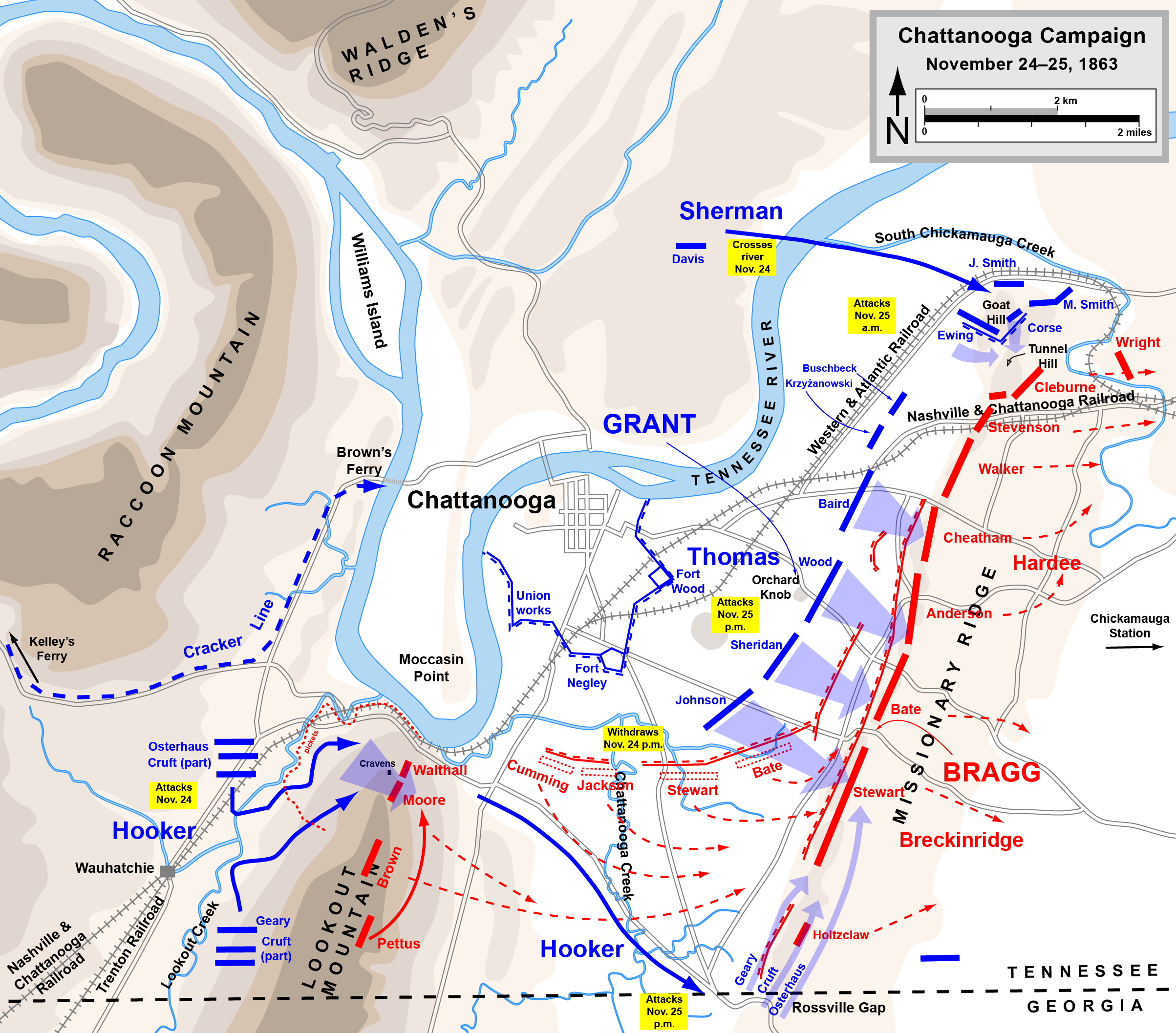
On this date in 1863, Federal troops scaled the heights of Lookout Mountain, southwest of Chattanooga, in a "battle above the clouds," and captured the Confederate position there.1 

By the end of the day, yesterday, Union Maj. Gen. Ulysses S. Grant's forces under Maj. Gen. George Thomas, attacked the center of the Confederate line on Missionary Ridge, and succeeded in taking Orchard Knob in front of the ridge. Maj. Gen. William T. Sherman attacked the north end of the Confederate line but was not able to overtake their strategic hold at the north end of the ridge where Great Grandfather Oakes is serving with Cleburne's Division in Lowrey's Brigade.

Source: Civil War Maps by Hal Jesperson

Lookout Mountain lay on the Union's far right. Union Gen. Joseph Hooker advanced his men toward the fog-covered peak, attacking Confederates posted at the base of the mountain.2 Hooker didn't actually plan to attack the entire mountain that day, thinking the steep granite slopes too precipitous to overcome quickly. However, fog masked the Union advance, and Hooker's men were able climb more easily than imagined. One Federal officer, Daniel Wait Howe, wrote, "During a considerable part of the day it was so foggy that we could see only the flashing of the guns, but at intervals the fog lifted, revealing the Federal line in the distance looking like a dark thread, slowly advancing from rock to rock. Then cheer after cheer went up from our own lines, for it was obvious that the Federal troops were steadily but surely gaining ground. Far into the night the flashes of musketry indicated that the weird 'battle among the clouds' had not ceased."

The Confederates at Lookout Mountain had overestimated the advantages offered by their position up the steep slopes, and 1,200 Rebels faced nearly 12,000 attacking Yankees. Artillery proved of little use, as the hill was so steep that the Rebels could not see their attackers until they suddenly appeared. Gen. Braxton Bragg did not send reinforcements because he believed the Union attack on the Confederate line on Missionary Ridge was more threatening than what was happening at Lookout Mountain.3

The Federals were victorious, and the Confederates were forced to abandoned the mountain by evening. In their withdrawal they were successful in destroying critical bridges over the Chattanooga Creek, thus separating Hooker's troops from the Confederates on Missionary Ridge. Their action will also significantly slow down Hooker's advance tomorrow on the south end of Missionary Ridge at the Rossville Gap.

The taking of Lookout Mountain was a huge morale boost to the Federals who had been cooped up in Chattanooga for the past 2 months. It wasn't long before the victors began referring to it as the "Battle Above the Clouds." The victory was soon amplified in the Northern press, which became the source for sensationalized and romanticized accounts of the battle. Considering the relatively small force involved and the small number of Federal casualties, Grant was content to refer to it as little more than a skirmish. In his memoirs he put the accounts into perspective: "It is all poetry."

"The Battle Above the Clouds"
A romanticized depiction of the Battle of Lookout Mountain
Source: Wikimedia Commons

Neither the advance yesterday on Orchard Knob, nor the storming of Lookout Mountain today was considered in Grant's original battle plan. Orchard Knob was intended merely as a reconnaissance to learn the enemy's position and to determine whether Bragg had begun to retreat. Taking Lookout Mountain began at Thomas's urging. But both attacks resulted in surprising and unexpected Federal successes. On the other hand, Sherman's attack, the main action, had failed to capture the north end of Missionary Ridge.4

So far, Confederate Gen. Bragg, although losing ground, has held on to his shaky footing on Missionary Ridge.

1 To see a 360-degree presentation of Lookout Mountain and the Chattanooga battlefield, visit the Civil War Trust Website, Chattanooga 360.
2 While Hooker was attacking Lookout Mountain, Great Grandfather Nathan Oakes, in the 32nd Mississippi Infantry Regiment in Lowrey's Brigade of Cleburne's Division, was quickly digging in for an anticipated attack by Sherman's troops on the north end of Missionary Ridge.
3 Historian Wiley Sword writes about Bragg's attitude toward defending Lookout Mountain: "Lookout Mountain had become dispensable in Bragg's eyes. Following the failures at Brown's Ferry, Wauhatchi, and the difficulties with Longstreet, Bragg simply didn't see the military usefulness of this giant mountain beyond that of an observation post." Considering the many Confederate casualties, it's tragic that Bragg hadn't acted on this opinion sooner and vacated the position.
Not all soldiers agreed with Bragg's assessment of Lookout Mountain's importance. It's loss certainly had some demoralizing effect on the troops. Capt. Daniel Colemen of the 15th Mississippi Battalion Sharpshooters in Mark Lowrey's Brigade expressed their sentiment when he wrote in his journal, "Sure enough the enemy did attack Lookout last night and carry it–It is a great blow to us–Reported that a large portion of [?] Brigades was captured" (from the D. Coleman Diary, #3317-z, Southern Historical Collection, The Wilson Library, University of North Carolina at Chapel Hill).
4 By evening, Grant erroneously supposed that Sherman had fought his way into possession of the north end of Missionary Ridge at Tunnel Hill. Based on this supposition, at midnight he issued an order for Sherman to attack the Confederates in his front in the morning. At the same time, he issued orders for Hooker to join in attacking the south end of the ridge. Thomas will launch his attack on the Confederates' center. These actions will bring on the decisive Battle of Missionary Ridge on the 25th.

Sources: Civil War Times, 1861-1865, Daniel Wait Howe; Autumn of Glory, Thomas Lawrence Connelly; Mountains Touched With Fire, Wiley Sword