In honor of Pvt. Nathan R. Oakes, CSA

150 years ago, my great grandfather, Nathan Richardson Oakes, served as a private in Company D of the distinguished 32nd Mississippi Infantry Regiment in the Army of Tennessee. He participated in the great Civil War campaigns, including the battles of Perryville, Murfreesboro, Chickamauga, Atlanta, Franklin, Nashville, and Bentonville. I am writing about his engagements as well as some details about fighting for the Lost Cause. I hope to honor him and commemorate the events and individuals that contributed to making this a renowned unit in the Confederate Army of Tennessee.

Showing posts with label Cleburne's Division. Show all posts

Sunday, November 30, 2014

"Let us die like men" | The Battle of Franklin, 1864

On today's date in 1864, the men of Confederate Gen. Patrick Cleburne's Division, in which my Great Grandfather Nathan Oakes served, got their first look at the Columbia-Nashville turnpike, along which they had slept in line of battle all night. They disappointed troops now knew for certain that the enemy they had battled the previous day had abandoned Columbia and Spring Hill. The anticipated attack orders from Gen. John B. Hood never came, and in the darkness all of Maj. Gen. John M. Schofield’s army had slipped by unchallenged.

Photo by Mark Dolan, June 2010
Rippavilla Plantation in Spring Hill, built in the 1850's,
and the home of Major Nathaniel Cheairs

In the early daylight hours, after breakfasting at the Nathaniel Cheairs home and quarreling with his commanders, Hood put his army in motion toward Franklin, marching rapidly in order to overtake the enemy before it crossed the Big Harpeth River, 18 miles north of the Confederates at Spring Hill. Hood, still unjustifiably angry,1 and even years later he still blamed the loss on his men:
A sudden change in sentiment here took place among officers and men: the Army became metamorphosed, as it were, in one night. A general feeling of mortification and disappointment pervaded its ranks. The troops appeared to recognize that a rare opportunity had been totally disregarded, and manifested, seemingly, a determination to retrieve, if possible, the fearful blunder of the previous afternoon and night. The feeling existed which sometimes induces men who have long been wedded to but one policy to look beyond the sphere of their own convictions, and, at least, be willing to make trial of another course of action.
It is hard to imagine how any of them could hold their commander in high enough esteem to be willing to offer the sacrifices he shortly would require of them. But being the valiant and loyal patriots they were, without hesitation, they will.

Photo by Mark Dolan, June 2010
The William Harrison House, where Gen. Hood planned his reckless
strategy that sent more than 1,700 men to their deaths at Franklin
About noon, Hood arrived with Maj. Gen. Alexander P. Stewart’s Corps along the Columbia turnpike, a mile south of Winstead Hill. He set up headquarters at the William Harrison House and there ordered his generals to report. Hood outlined his plan to risk everything on a direct, frontal assault on the Federal lines. When he asked for comments, Gen. Nathan B. Forrest objected because he saw that a direct assault would bring on a great and unnecessary loss of life. Forrest offered to lead his cavalry and some infantry to flank the Federal position. Gen. Benjamin Cheatham and Cleburne added that an attack across 2 miles of open valley against impregnable earthworks would be a disaster.

Still stinging from his lost opportunity the night before, Hood was emphatic with his orders this afternoon: The attacking Confederate force was to “go over the main works at all hazards.” Obediently, Cleburne’s last words to Hood were, “I will take the enemy’s works or fall in the attempt.” Tragically, Cleburne will be true to his word.

Source: Civil War Maps by Hal Jesperson
View an exceptional animated map available at the
Civil War Trust website
Gen. Cleburne then rode back to his command and passed the orders to his brigadiers, instructing them to march their troops up to the foot of Winstead Hill, east of the turnpike. Gen. Daniel Govan later remembered Cleburne being despondent on this afternoon, and tried to engage him in conversation: “Well, General," he commented, "there will not be many of us that get back to Arkansas.” To which Cleburne replied, “Well, Govan, if we are to die, let us die like men.” 

Though hastily constructed, the Federal entrenchments were significant, made of earth and logs. This imposing line extended around the town. The dirt on each side of the trenches had been used to elevate the works, creating a ditch in the front and rear. Twenty-eight cannon were spread throughout the line. The battle would mainly take place on the plantation of Fountain B. Carter. His cotton gin, less than 100 yards east of the Columbia pike, was strategically located along a natural defensive line. There Federal troops had scavenged lumber from the cotton gin to reinforce their barricades. Along the crown of the embankments, a top rail was placed with space beneath from which to fire their rifles. In some sections these works rose 5 feet high and 4 feet or more thick. Artillery had also been deployed behind other earthworks. The Yankee position was formidable.

Photo by Mark Dolan, June 2010
The Fountain Branch Carter House: Gen. Jacob Cox's headquarters
and center of the Confederate attack. The Carter family and neigh-
bors huddled together in the basement during the battle.
The Carter House was located in the center of the Federal's defensive arc. The home was set back about 45 feet west of the road. It was located on a prominent hill, which Union Maj. Gen. Jacob D. Cox saw as the key to his entire defensive line. Here where the road passed by the house, a gap was left in Cox’s defenses to allow wagons and the rest of the army to pass through. This gap was covered by a second line of breastworks, about 100 yards long, 70 yards to the rear of the first line, along the northern edge of Carter’s garden, where a wood frame farm office and brick smokehouse stood. The main Federal line of breastworks continued westward from the southern edge of the garden, then northwest along the side of the hill until it ended in a wooded area at the Carter’s Creek pike. Beyond that pike, the line was extended to the Harpeth River. About 17,000 Federal troops were ensconced behind these defenses, awaiting their turn to cross to safety over the Harpeth River and on to Nashville

Photo by Mark Dolan, June 2010
Confederate view today  from Winstead Hill of the Columbia Pike, which leads
north to Franklin. Cleburne's Division attacked the center of the Federal fortifi-
cations to the right of this road.

After receiving his orders, Cleburne rode from Winstead Hill to Breezy Hill to meet with his brigade commanders. He then rode forward to Merrill Hill where he could observe the imposing enemy lines. The Federals obviously were attempting to cross the river over the narrow bridges. However, their infantry was well entrenched and posted about 300 yards in front of the main line. Beyond at Fort Granger, an earthen fortification northwest of the Harpeth River, there were long-range Federal artillery, which could reach the advancing lines of Confederates. Before Cleburne's Division could assault the first Federal line, his men would have to cross more than a mile of open ground, all the while exposed to direct rifle and artillery fire. It would be a desperate and costly attack.

Before 3 PM, Cleburne’s brigades had moved up to deploy on the forward slope of Breezy Hill in columns by brigades. Given the present situation, advancing columns would expose fewer men to the direct fire of the enemy. Just before their final charge Cleburne would reorganize them into lines. He placed Hiram Granbury’s Brigade plus the 35th Tennessee next to the turnpike. Govan’s Brigade was placed in the center and Mark Lowrey's Brigade (Great Grandfather's) on the right (east) of the turnpike, following behind. As was his custom, Gen. Lowrey, an ordained Baptist minister, delivered a short sermon to his men.

It was going to end up a hand-to-hand fight, so Cleburne directed his men to load their rifles, but save their ammunition in preference to bayonets.
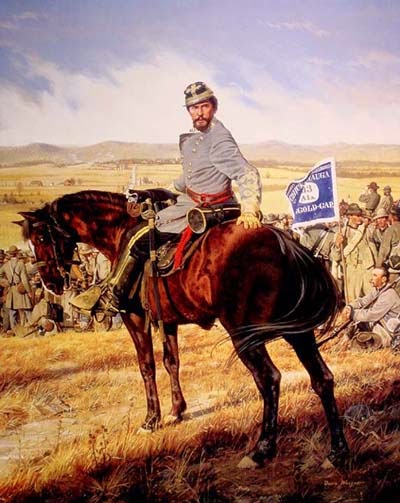
An hour now had passed, and it was almost 4 PM. Sundown came early at this time of the year, so the attack would have only about 35 minutes of sunlight. Using the topography as an advantage, Hood had ordered Stewart’s Corps on a flanking march east through the woods, around the base of Breezy Hill to the Lewisburg pike, to cut off the enemy’s retreat. Stewart’s Corps would follow the Lewisburg pike north and strike the lines near the railroad. On the flank, the rest of Forrest’s cavalry, would support Stewart’s advance, then cross the river and destroy the Federal wagons. William B. Bate’s Division of Cheatham’s Corps would swing west along the knoll at the enemy’s lines near the Carter house. James R. Chalmer’s Division of Forrest’s cavalry would advance along the Columbia pike to support Bate. 

"Cleburne" by David Wright
Partick Cleburne viewing his
troop before the attack
The rest of Cheatham's Corps—Cleburne's and John C. Brown's Divisions—readied to make the frontal assault on the center of the Federal line. Brown's Division followed the west side of the pike while Cleburne's men moved up the right. It would be here in the center that the most vicious fighting would take place, and Cleburne's men would see the worst of it. The army had only two 6-gun batteries. One battery was assigned to each corps, and split up to fill in the gaps between divisions.

At the signal from Winstead Hill at 4:00 PM, the hardened Confederate troops began their fateful march. Brigade bands, which for the first time carried their instruments into battle, struck up "Dixie" and "The Bonnie Blue Flag" as if they were going on parade. It was an amazing spectacle to behold and was forever remembered by participants on both sides. "In the whole history of the war," writes historian Stanley F. Horn, "there never was such an imposing military spectacle as was here presented—eighteen brigades of infantry, with their cavalry support, marching in a straight line across an open field, in full view of their commanding general and of the entrenched enemy." The advancing corps, with banners waving, created a line almost 2 miles wide with a force half again larger than Pickett’s Charge at Gettysburg. But these Confederates had twice as far to march. Considering the enormity of the battle and the slaughter that was to come, it's astounding that the Battle of Franklin is not at least as well known as its eastern counterpart.

Since Schofield's troops at Franklin had not planned on making a stand there (Schofield had been ordered by Gen. George Thomas to abandon Franklin and retire to Brentwood), they were astounded by what they witnessed: Seemingly, the entire Confederate army was approaching. As sunset neared, 22,000 Confederates began their march.

Source: Civil War Maps by Hal Jesperson

Cleburne rode with his advancing line of 3 brigades. He guided his division toward the first Federal defenses, manned by Gen. George D. Wagner's division, using the Columbia turnpike on the left as a guide, and the Carter house as his target. Almost as soon as Cleburne's men came into the open, Federal batteries opened fire, tearing holes in his advancing line. His officers ordered the men to close up and fill the gaps as the advance continued. A few Confederate guns were able to fire above the men and into the enemy soldiers, now only 400 yards away from the advance. It took almost 15 minutes for Cleburne’s leading division to advance the first mile, adjacent to Privet Knob.

At this point, Cleburne halted his brigades and reformed his men into 2 attacking lines. The other divisions did the same. When Cleburne's lines were within a hundred yards of the advanced Federal position, the enemy fired into them, only slowing the determined Confederates momentarily. Raising the Rebel yell, Govan's and Granbury's men charged toward the 2,000 soldiers of Union Col. Joseph Conrad's exposed brigade. Cleburne urged his men forward, and his troops were soon on them in the first breakthrough in the Federal line. A brief hand-to-hand struggle erupted, but the line soon crumbled, and the Federals ran. Scores of the enemy were killed, wounded, or captured as they fled.2 

Cleburne and his troops closely pursued Wagner's broken division, intending to smash them into the main Union works in the rear. But the throng of running soldiers soon became intermingled. Federals behind the main defensive lines were forced to withhold their fire for fear of hitting their own returning troops. Cleburne's men now were aiming for Carter's cotton gin directly ahead on the right (east) side of the road. Cleburne spurred ahead into the mass of men, and was charging diagonally across the front of his own brigades toward the center of the line when his horse was killed. Picking himself up, he was given another. He had only started to mount when this horse also was also shot. He decided to draw his sword instead and lead the charge on foot.


Photo by Mark Dolan, June 2010
View across Cleburne Park to the area of the Cotton Gin (about where the blue
house in the center background sits), scene of some of the fieriest fighting. Thanks
to the Franklin's Charge and the Civil War Trust, the area around the former Cotton
Gin has been reclaimed, and the new Cotton Gin Park will be opened this year on
the sesquicentennial of the Battle of Franklin.

The Federal riflemen and those manning the cannon, had an open field of fire, and by now, the they could hold their fire no longer. Men of both armies were cut down. A wave of Confederates pressed to the enemy's line and halted in the ditch below the earthworks. Undaunted, Cleburne’s Division pursued the fleeing defenders. The unstoppable men seized the 4 guns at the pike about 110 yards from the main line, and gained the outside of the main works east of the cotton gin, killing, wounding, and capturing 250 enemy. In the midst of the melee, Gen. Granbury was struck dead with a bullet to his head.

Cannon shell pyramid near where Cleburne fell
Several hundred of Cleburne’s men surged over the embankments and through the gap left in the defenses at the pike. One of Granbury's or Govan's men planted Cleburne's blue divisional flag atop one of the defensive embankments. East of the pike and within 40 yards south of the enemy's works, a single enemy bullet ended the life of an extraordinary Southern hero. Gen. Cleburne was hit in the chest and killed instantly. “It was the work of but an instant," wrote historian Wiley Sword, "a great chasm in Southern history frozen in microseconds. In one shocking moment Pat Cleburne collapsed to the ground, carrying with him perhaps the best hopes of a dying Confederacy’s western army.”

Lowrey's Brigade, which followed, was now near the cotton gin and the center of the inferno at the gap. Gen. Lowrey, at the head of his brigade, brought his men forward “under the most destructive fire I ever witnessed.” Unaware that their commander had fallen, the rest of Cleburne’s Division continued its momentum on and beyond the main line, facing a force that had just repulsed Stewart’s attack on the right (Stewart assaulted the main line as many as 13 times, but was unable to penetrate). As Cleburne’s men now attacked, they came upon terrible fire from their right. Here the fighting became even more severe. 

Along the line there followed a series of uncoordinated assaults. Brig. Gen. John Adams’s Brigade of Stewart's Corps, approached to within 50 yards of the earthworks, where his men were met with deadly fire. As his brigade attempted to advance the general was killed while trying to jump his horse over the embankment, abut 100 yards east of the pike. Near here, Brig. Gen. Francis M. Cockrell, wounded 3 times, finally was pulled over the works and captured by Yankee soldiers. Brig. Gens. William A. Quarles and Thomas M. Scott were also severely wounded. 

West of the pike, Brown’s Division captured about 150 yards of the main line. Parts of 2 of his brigades went over the breastworks and advanced some distance within the works. However, a Federal countercharge drove them back. The men continued to hold their ground along about 75 yards of the outside of the works until the battle ended. Brig. Gens. States Right Gist was mortally wounded and Otto F. Strahl was killed. Gen. Brown, also was badly wounded. Capt. Tod Carter, whose family's home was within sight, was mortally wounded as well.

Throughout the center of the battlefield the slaughter for both sides was greatest. Gen. Cox wrote that the Federal loss in killed was "trifling everywhere but near the center." Historian Eric Jacobson notes,
The clash was uncommon even in a war that had dragged for nearly four years. At Franklin it was if all sense of morality vanished entirely. A war that had started with pomp and grandeur had spiraled into a bloody and gut-wrenching struggle, where victory could only be achieved by an absolute extermination of one side or the other.
Mobs of men continued to stream up the turnpike and swarm into the Federal defenses. As the first hour of fighting wound down, the killing was far from over. Federal forces on both sides of the turnpike crumbled.

By this time, Federal Gen. Emerson Opdycke, who understood his army's peril, led his brigade in a disorganized counterattack toward the gap in the east side of the pike. Men from Cleburne's and Brown's Divisions slammed into them, resulting in a brutal hand-to-hand fight, a maelstrom that few of the hardened soldiers had ever witnessed. Scattered troops from both sides fired from all directions. Men fought each other to death with anything at hand. “The collision of the 2 mobs amid the Carter house and the outbuildings became a lifelong memory,” wrote historian Wiley Sword. "It was a hand-to-hand combat that witnesses could never describe accurately or portray fully."3 

The Carter office building and smokehouse beyond
By sheer weight of numbers, the Federals began to force their way forward to strengthen the Federal line. But the furious Confederate attack did not stop. Trailing brigades of Cheatham’s Corps continued to arrive and assault the Federals in the Carter garden and around the home. On the north side was the smokehouse and farm office outbuilding, where Opdycke’s and other brigades fought behind the low rail barricade and garden fence. Across the bare garden to the south Confederates returned fire from the main earthworks. Faced with overwhelming numbers, the Confederates eventually were forced to withdraw. In the chaos and choking smoke, Federal soldiers took 394 prisoners, including 19 officers and 9 battle flags.4

Photos by Mark Dolan, June 2010
Bullet holes are still visible in many of the Carter buildings.
Brown’s, Cleburne’s, and some of Stewart’s troops now stubbornly held the outside perimeter of the Federal entrenchments east of the house. Some tried going over the works, but were either shot or pulled over to be made prisoners. Both sides fired blindly over the top or through the space below the head logs. As their ammunition ran out, soldiers were forced to rummage through their fallen comrades for more. Govan later wrote, that when his brigade advanced to the main line of entrenchments, “here commenced the most desperate fight I ever witnessed which lasted until near midnight. Our men occupying one side of the breastworks, the Yankees the other.” About 300 Confederates were forced to surrender, among them Brig. Gen. George W. Gordon who with some of his command had strayed to the right and now were mingled with Granbury's men.

While the desperate struggle around the Carter buildings was taking place, Lowrey's men and other soldiers from Cleburne's command continued to battle Federals on the main line east of the pike to the cotton gin. Gruesome fighting ensued as the Confederates held onto the outside of the embankments all the while receiving horrible crossfire from the cotton gin on their right. To add to their misery and frustration, the earthworks had been constructed so that the Confederates could not fire without exposing more of their bodies than the Federals. Only feet away on the other side of the mound, Union troops took turns firing on their attackers. Those in the rear reloaded and passed their muskets to those on the front of the defenses. Whenever a Confederate raised his head he was immediately shot. There was nothing else they could do but fire blindly back and forth. For those approaching, the smoke was so dense that the enemy’s works couldn’t be seen until only a few yards from them.

Gen. Lowrey's men did everything that was humanly possible to succeed. The enemy which had been driven from the first line was now ensconced behind a second defensive line and held the Confederates in check. "I threw my brigade into the outside ditch of his massive works," wrote Lowrey, "and my men fought the enemy across the parapet." To this point, half of his men were already dead or wounded, "and the balance could not scale the works. It would have been certain death or capture to every one of them." Leading his men on horseback, Lowrey made it to within 30 feet of the works when his horse was wounded.

Although the men fought bravely, nevertheless their assault was doomed. Ultimately, many more men were killed or captured by the time all hope of success had failed them. Lowrey's Brigade, which had suffered the most casualties at Spring Hill the day before, now experienced further decimation. Finally, Lowrey wrote, "When I saw nothing else could be done, I went to the rear, and began the work of gathering up the fragments of our division.”

The Confederates fought well into the night. About 7:00 PM, Hood finally ordered forward one more division, Maj. Gen. Edward Johnson’s of Lee's Corps, to help the center. However, his division also was decimated in a courageous attack. Brigade commander, Arthur M. Manigault, was severely wounded. 

Each side had tried and failed to control the few acres of open ground that had been Carter family’s home and farm. By now, darkness covered the bloodied battleground. While Cleburne’s and Brown’s men had partially carried out their objective and held a portion of the works until the end of the fighting, a stalemate was the best that could be reached at the crucial Carter house hill. Even as darkness enveloped the savage scene, the 2 sides continued to fight stubbornly beyond the point of exhaustion. Finally, near 10 PM, the firing died down, and both sides withdrew.

In this, the bloodiest 5-hours of the war, Hood’s loses were appalling—approximately 7,000 killed and wounded—nearly a third of those he ordered into battle. In addition to the unprecedented loss of 6 generals, a significant number of regimental commanders and other officers were killed or wounded. Sixty-five Confederate commanders of divisions, brigades, or regiments were listed as casualties. Thirteen generals were were injured or captured.

Cleburne’s Division, as it had nobly done so often, sustained the greatest loss of any other—over one-half. The Confederates' losses at the Battle of Franklin all but guaranteed the defeat of the Army of Tennessee at Nashville 16 days later. More importantly for the South, it hastened the doom of the Confederacy.

Photo by Mark Dolan, June 2010
The McGavock Confederate Cemetery

Fourteen men from Great Grandfather Oakes's 32nd Mississippi Infantry Regiment were buried at McGavock Confederate Cemetery on the Carnton Plantation in Franklin. As many as 5 of these were from his company, Co. D. For Great Grandfather Oakes, like thousands of others, the loss hit on a personal level with the death of a close friend. Thirty-five years later, he wrote a short letter to the editor of the Confederate Veteran to commemorate him:
The Confederacy lost one of her bravest when Comrade [Miley] Steele fell dead at Franklin on top of the breastworks to the left of the pike 5 leading from Columbia into the town. He was never heard to murmur or to disobey, and professed great faith in the cause of the South and in the ability of our leaders. Above all, he was a true Christian, having joined the church at Dalton, Ga., a fact which his relatives never knew.

Photo by Mark Dolan, June 2010
The Mississippi Section of the McGavock Confederate Cemetery where
424 of Great Grandfather Nathan Oakes's comrades were laid to rest

According to the historians Purdue, the death of Maj. Gen. Patrick R. Cleburne had a swift effect on the army and soon the Confederate people. Troops could hardly believe that such a calamity had befallen the army. Some of his men visited the Carnton House on the morning of Dec. 1, for a last look at their general. Gen. William Hardee later commented, “The death of Cleburne cast a deep gloom over he army and the country. Eight millions of people, whose hearts had learned to thrill at his name, now mourned his loss, and felt there was none to take his place.”
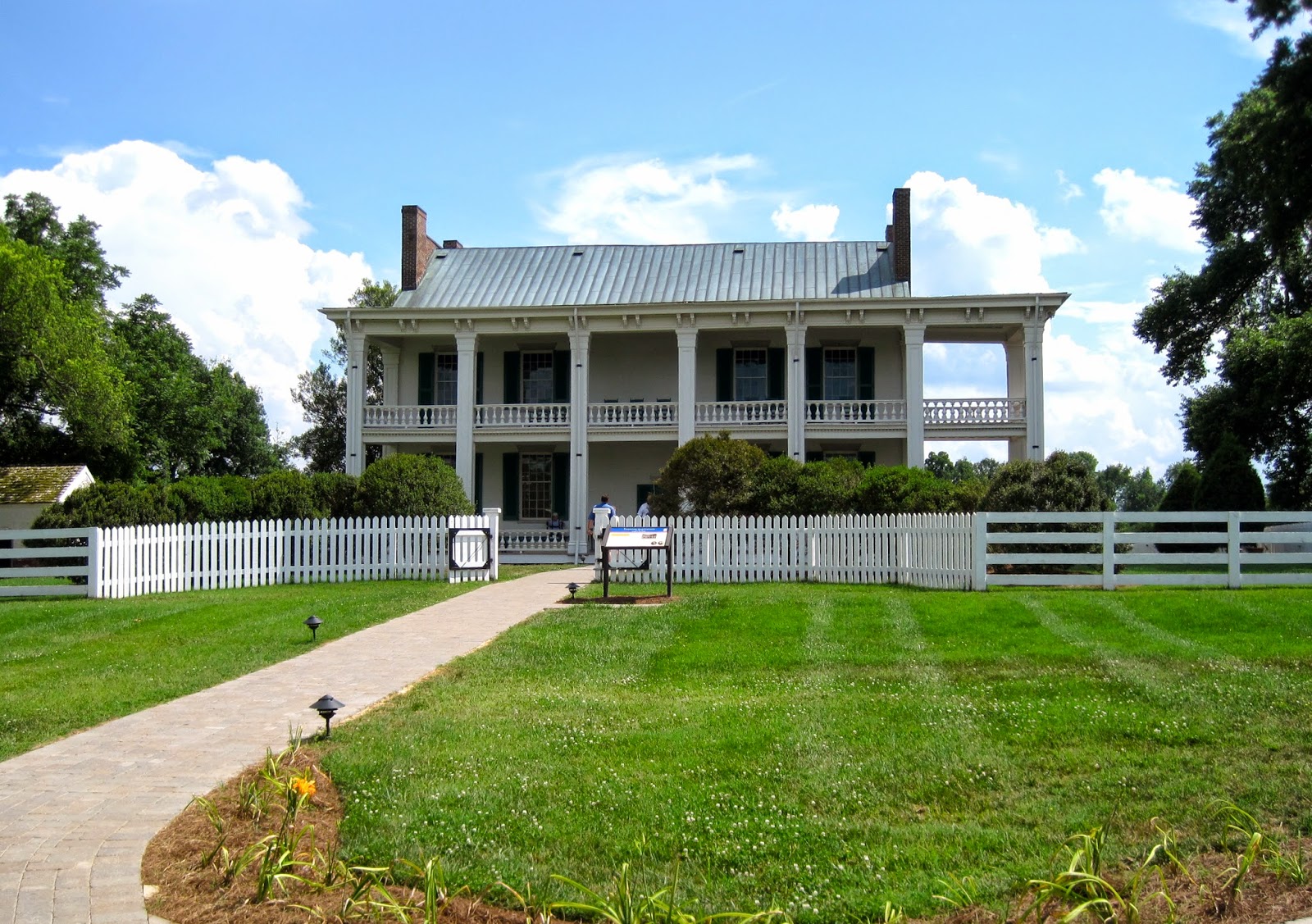
Photo by Mark Dolan, June 2010
The Carnton Plantation House
After the Battle of Franklin, the bodies of 4 of the 6 slain
Confederate generals were laid for viewing on the lower porch.
Even though Cheatham's, Stewart's, and Stephen D. Lee's Corps had been massacred in the battle, nevertheless, Hood planned to attack again the following morning. Confederate batteries were placed on the high ground at Winstead and Breezy Hills. In their rush in the darkness to get positioned on the heights some of the guns inadvertently were rolled over the dead and wounded. However, by 2 AM, the Federals, leaving their own fallen troops, slipped away under cover of night over the river, burning the bridge behind them. It was just as well. Hood's forces were too decimated to take up another attack. Brigades were left without their generals, regiments without colonels, and other field officers were in too short supply to reorganize the men into anything like a fighting force.

Schofield was amazed at the Confederate attack. His assignment to Cox for the preparation of defensive breastworks had been intended only as a temporary threat to Hood while he evacuated his Federal army. But as it happened, it was Cox's prudent preparations and Opdycke's and other officers' bold actions that saved Schofield’s army from disaster at Franklin.

__________________________________________________________________

'Pickett's charge at Gettysburg' has come to be a synonym for unflinching courage in the raw.
The slaughter-pen at Franklin even more deserves the gory honor.
Stanley F. Horn
________________________________________________________________________

1 Historian Craig L. Symonds concluded that instead of supervising the action at Spring Hill on the 29th, the disabled Hood had retired to his headquarters at the Thompson Mansion for an early dinner and a laudanum-induced sleep. Moreover, there is strong evidence that Hood knew that night that his troops were not holding the Columbia-Franklin turnpike. Both Cheatham and Stewart wrote later that before he went to bed, he was already criticizing the army for its lack of energy, and in particular for its failure to seize the turnpike. Others agree. 
2 Author and Battle of Franklin historian Eric A. Jacobson provides a compelling narrative of the "Breakthrough" and also the bitter fight at the Cotton Gin, in his video available at the Civil War Trust website. When my wife and I visited the Franklin battlefield in 2010, we were introduced to Eric Jacobson at the museum there. He was gracious enough to spend more than an hour discussing the battle and answering my questions. His book about the Battle of Franklin, For Cause & For Country, is one of the best to be published in recent years.
3 Indeed, the fighting almost everywhere beyond the Federal line was vicious and brutal. As an aged veteran, Frank Cheatham, returned to Franklin where he met a Union veteran who seemed uncertain about being in the company of a former enemy of that terrible battlefield. Cheatham embraced him and said reassuringly, “Any man who was in the battle of Franklin, no matter which side, is my friend” (Sword). Another witness to the carnage, Pvt. Sam Watkins, who fought on the left of the pike, describes his impression like this:
Kind reader, right here my pen, and courage, and ability fail me. I shrink from butchery. Would to God I could tear the page from these memoirs and from my own memory. It is the blackest page in the history of the war of the Lost Cause. It was the bloodiest battle of modern times in any war. It was the finishing stroke to the independence of the Southern Confederacy. I was there. I saw it. My flesh trembles, and creeps, and crawls when I think of it today. My heart almost ceases to beat at the horrid recollection. Would to God that I had never witnessed such a scene!
4 In this counterattack, Federal Major Arthur MacArthur of the 24th Wisconsin, hero of the Battle of Missionary Ridge and father of Gen. Douglas MacArthur, was severely wounded.
5 Great Grandfather's reference to soldiers from his division (Patrick Cleburne's) fighting to the left of the turnpike is the only one I know of. All other reports place the 32nd Regiment in the center of the fighting, but to the right of that road. Of course, in the confusion of the battle, it is very possible that solders like Steele and my great grandfather became mingled with other units and were separated from their commands.

Sources: Advance and Retreat, John B. Hood; Stonewall of the West, Craig L. Symonds; Pat Cleburne: Confederate General, Howell & Elizabeth Purdue; For Cause & For Country, Eric A. Jacobson; The Army of Tennessee, Stanley F. Horn; Five Tragic Hours, James Le McDonough & Thomas L. Connelly; Mark P. Lowrey Autobiography; Military Reminiscences of the Civil war, Jacob Dolson Cox; Co. Aytch, Sam Watkins; Confederate Veteran, Vol. 8; Official Records, Vol. 45, Pt. 1

Tuesday, September 2, 2014

The Second Battle of Lovejoy's Station, 1864

Following the Battle of Jonesboro from August 31st to September 1st in 1864, and the loss of his railroad, Gen. John B. Hood's Army of Tennessee withdrew from Atlanta, south to join William Hardee's Corps at Lovejoy’s Station. Trainloads of wounded and supplies were being transported from Atlanta through the station and on to Griffin.

Source: House Divided

On today's date in 1864, there was fighting with the enemy all along the Flint River to McDonough. Union Gen. J. M. Schofield followed after the retreating army, probing the Confederate defenses. On September 3rd, he confronted Confederate Gen. Stephen D. Lee's Corps at the Flint River, along and northwest of Lee’s Mill Road. Lee's men engaged in heavy skirmishing in this action, defending the Confederate position there.*

On the same day, my Great Grandfather Nathan Oakes, withdrew from Jonesboro with Mark P. Lowrey's Brigade in Patrick Cleburne's Division of Hardee's Corps, arriving near the same railroad station. Hardee's troops, about 10,000, form a line of battle along a low ridge called Cedar Bluffs, running east to west. About 2 PM, the Federals approached Hardee's line. By late afternoon, they had repulsed the Federal attack, directed in person by Gen. William T. Sherman. Gen. Lowrey reported the action of his brigade:
I arrived one mile east of Lovejoy’s Station, upon the McDonough road, at 6 o’clock on the morning of the 2nd of September. I formed line, with Mercer’s brigade upon my left and Granbury’s upon my right. The general direction of my line was east and west. At 10 a. m. I had my line formed in single rank, and went to throwing up breast-works. At 3 p. m. the enemy made their appearance in front of my pickets. A sharp skirmish commenced, which was kept up until 4 p. m. The enemy advanced upon my picket-line with a strong line of skirmishers and two lines of battle; drove in my pickets, broke the picket-line to my right, and captured some of my pickets. The ground was so situated that the enemy, after breaking the picket-line to my right, was in rear of some of my pickets before they could be observed by them. After breaking my picket-line, they made a charge upon my works (they not being completed) with their first line, coming within 250 yards of my works, but were handsomely repulsed. They attempted to bring up a second line, but with no better success than the first. From their graves, that were in my front, and from the report of two officers from the brigades that were captured upon the picket-line (who have since been exchanged), their loss was very heavy, considering the time that we were engaged. The officers captured report that their pickets wounded 1 brigadier-general and several line officer and privates...

My pickets fought the enemy, driving back the skirmish line, and until their line of battle was within forty steps of their barricades and in rear of a part of my picket-line. My loss was 1 killed, 9 wounded, and 39 missing.
With Atlanta now in Federal hands, Gen. Sherman decided to conclude his campaign, which began on May 7, near Dalton in the Battle of Rocky Face Ridge. He will now devise other plans for the destruction of the Southern homeland. On the 3rd, he telegraphed Washington the famous words, "Atlanta is ours, and fairly won." Almost immediately, he cruelly expelled the citizens of that city and transformed it into a military garrison.

On the 3rd and 4th, Hardee's Corps at Lovejoy Station was joined by 2 other corps, Lee's and A.P. Stewart's. Deciding not to press his advantage, on the 6th, Sherman withdrew his force to Atlanta. Had he wanted to, he likely could have dealt a decisive blow here to Hood's army. On the 8th, Hardee moved back to Jonesboro.

By the conclusion of Sherman's 1864 Atlanta Campaign, the Army of Tennessee had lost upwards of 9,000 men. Sherman sustained about 24,000 casualties. Of course, there was incalculable destruction of civilian life and property over the 2 months of near constant fighting.

* The First Battle of Lovejoy Station was fought on August 20, 1864, between Cleburne's Division and a raiding party of Federal cavalry.

Sources: Pat Cleburne: Confederate General, Howell & Elizabeth Purdue; The Army of Tennessee, Stanley F. Horn; Decision in the West, Albert Castel; Official Records, Vol. 38, Pts. 3, 4, & 5

Sunday, August 31, 2014

The 2-day Battle of Jonesboro, 1864

Photo by Mark Dolan, June 2010
The Battle of Jonesboro, which began on this date in 1864, lasted from August 31 to September 1. It was the last significant battle of several fought in and around Atlanta in the summer of 1864. The Battle of Jonesboro was Federal William T. Sherman's attempt to cut Confederate Gen. John B. Hood’s railroad supply lines and force him to withdraw his army from Atlanta. My Great Grandfather Nathan R. Oakes served in Maj. Gen. Patrick R. Cleburne's Division of Gen. William Hardee's Corps, which had a prominent, albeit disappointing role in this fight.

On today's date in 1864, Hardee was at Hood's headquarters to discuss the recent movements of Sherman's army and to draw up plans for an attack. Hood assigned Hardee command of the entire front from East Point to Jonesboro. He ordered Hardee to coordinate an attack at Jonesboro with Stephen D. Lee's Corps (Hood's old corps). In his absence Hardee had left Gen. Cleburne in command of his corps, who would continue to command Hardee's men throughout the next several days.

The concern for Hood was the appearance on August 30 of a Federal column near Jonesboro. Hood ordered Hardee to assault the Federals at Flint River near the Macon & Western Railroad, which by now were entrenched behind fortifications there. Hardee's orders were to drive the Federals into the river "at all hazards." It was a difficult assignment, and if the attack were not carried, it would result in Hood's army having to evacuate Atlanta.

Overnight, the enemy had crossed the river and was a half-mile west of Jonesboro and the railroad, facing east. Gen. Cleburne, commanding Hardee's Corps, had been ordered to march his troops through the night, south to Jonesboro to meet the threat. It was a slow and difficult march under constant threat of attack. The tired men arrived about sunrise and soon were placed into position in a line west of the railroad. The line now stretched about 1.5 miles from just below Jonesboro to just above the town. Lee, whose corps arrived about 1:30 PM, was placed just west of the railroad to Cleburne's right. At this point there were about 20,000 Confederates along the line.

Brig. Gen. Mark P. Lowrey
The battle plan called for Cleburne to attack the southern flank of the Federal bridgehead in a sweeping movement from south to north. Lee's Corps would follow up Cleburne's attack. Cleburne placed Brig. Gen. Mark P. Lowrey, Great Grandfather Oakes's brigade commander, in charge of his division. Lowrey's division, on the extreme left of the Confederate line west of Jonesboro on the Fayetteville Road, would lead the attack. He would swing Cleburne's Division northward to strike the Federal right flank. Lowrey positioned Hiram Granbury's Brigade on the left. His own brigade, temporarily under the command of Col. John Weir, was placed in the center. Mercer's Brigade, commanded by Colonel Charles H. Olmstead, was placed on the right. Daniel Govan's, in reserve, was in the rear of Granbury's. John C. Brown's Division was to the right of Lowrey's division. "Each man was provided with sixty rounds of ammunition" reported Lowrey, "and all were informed that General Hood expected them to go at the enemy with fixed bayonets, and drive them across the river."

Source: House Divided

Hardee's artillery opened the battle at 3 PM, and by 3:15, Lowrey's brigades moved forward with fixed bayonets. Very soon, his men came under fierce fire from artillery and dismounted cavalry posted behind defenses in an open field about 300 yards from the river. At this point, Col. Weir reported1 that he ordered his (Lowrey's) brigade to charge. The other brigades did the same. They soon routed the Federals, sending them into a retreat to a second line of defenses, before driving them across the river. In their exuberance Granbury's Regiment, followed by Lowrey's and Mercer's, pursued the fleeing Yankees across the river. They gained another line of defensive works; however, they had now exceeded Lowrey's orders—or at least his intention. While successful in this gallant charge, the problem now was that Lowrey's brigades had ignored taking the entrenched Federal infantry on their right (north). Lowrey reported the action on the 31st in this way,
Both artillery and small-arms opened vigorously on my lines, but after a short contest the enemy fled in confusion, and were pursued by my command with great impetuosity. A portion of this force made a slight stand at a second line of works, to hold us in check while the remainder crossed Flint River; but the stand was only slight, and all soon fled in great confusion, leaving in front of Lowrey's brigade 2 pieces of artillery in a deep slough near the creek. Contrary to instructions, Granbury's brigade crossed the river for the purpose of driving a battery from the next hill, which was doing some execution in our lines. Too full of impetuosity, Lowrey's and Mercer's followed the example, and the enemy was driven from another line of works beyond the river. I immediately ordered the brigade commanders to bring their commands back and form their lines on this side of the river. Observing that we were far in advance of the troops on our right, and that the connection on the right was entirely broken, I immediately ordered Brigadier-General Govan to change the direction of his line and unite with the forces on our right, and press the enemy's flank, if a flank could be found, assuring him that I would join him with the other three brigades as soon as possible. Pending the movements and the reformation of the other brigades, I galloped to the right to make observations. I found that the enemy was in good works the right of the flank of which rested on the river, and that Cheatham's division, under command of Brigadier-General Maney, had come in and occupied the ground between my command and the enemy's infantry works. But supposing a charge would be ordered, I was making all haste to get in position to join in the assault, when I received an order from Major-General Cleburne to return to the position from which I started.
Lowrey was now ordered to move his division to the right in support of Lee. However, after shifting about 600 yards in Lee's direction, Hardee ordered him to halt and await further orders. Soon, Lowrey was ordered back to the place from which his attack had started.

By now, it was becoming evident to Cleburne that his planned sweep of the Federal line had fallen apart. Lacking the support of Lowrey's division, Brown's Division with George Maney's behind, lost much of the impact it needed in its attack to the north. Even after Cleburne added 2 other brigades to the attack, Brown's assault unraveled. Lowrey's troops were out of the main action, Brown's men had been repulsed, and Maney's attack was called off. Lee, who mistakenly had preempted Cleburne's attack by an hour, was unable to advance to the enemy's line, and was driven back with heavy losses. Hardee had little choice but to order Cleburne and Lee to cancel their attacks an fall back to their original line along the railroad.

Lowrey, whose men achieved the only real success of the day, reported a loss to his division in this attack to be 28 killed and 147 wounded. Hardee's total loss was at least 2,000. The enemy lost only 172.

In fairness to Hardee's men, his 2 corps were unable to drive portions of 4 Federal corps, personally directed by Sherman. Regardless, Cleburne, who was leading the corps for the first time in battle, was not successful in leading his troops to victory. And Lowrey, for his part, was also unable to clearly communicate with his division the important strategy for his portion of the attack, although in his report he stated that his men acted "in obedience to the order given [and] drove across the river all the enemy that was in their front." He also admitted,
I did not swing as much to the right as I intended to do, for the reason that the enemy was farther to my left than was expected, and to have done so would have left the enemy in works on this side of the river on my left flank and in my rear. My left brigade encountered the strongest force of the enemy and sustained the greatest loss.
That night, Hardee ordered Cleburne to pull back to within a mile of Jonesboro. Hood had recalled Lee's Corps to Atlanta in response to a new threat southwest at the railroad at Rough and Ready—the enemy was destroying the railroad between there and Jonesboro. Hood interpreted the battle at Jonesboro as an attack on Atlanta from the south and began considering an evacuation of the army. At 1:30 AM, Lowrey was ordered to move Cleburne's Division to relieve Lee's departing corps. Still commanding Lowrey's Brigade, Weir posted his men in the center between Granbury on his right and Mercer on his left.

Lowrey now had only a thin line to replace Lee's entire corps. His men were left to form scant defenses with what little material was nearby. Their line was so close to the enemy that several from Mercer's brigade were attacked and captured.

The departure of Lee's Corps will have a direct influence on Cleburne's fight the next day.

On September 1st, Cleburne's corps, now entrenched in a single line around Jonesboro, and under fire from the enemy's sharpshooters and artillery, faced the overwhelming numbers of 6 Federal corps. Throughout the day, the Yankees prepared for an attack on Cleburne's position, which had no natural defenses. Col Weir put his brigade to work improving their defenses, which were subjected to constant fire from Federal sharpshooters and artillery.

Gens. Hardee and Cleburne had decided to use Hardee's outnumbered corps to make a brave stand to hold back the Federal troops, most of the Union army, while providing the time needed for a safe retreat of the Confederate army from Atlanta to Lovejoy Station. But Sherman had a plan to envelope Jonesboro and destroy Hardee's Corps.

By early afternoon, the enemy was seen to be moving to the right Lowrey's position, which was holding the north end of the hooked line that curved back a mile north of Jonesboro. It would be against this northern angle that the main Federal attack would come. Hardee strengthened this part of the line by assigning Lowrey 2 additional brigades, Lewis's and Gist's (command by Col. James McCullough). Lowrey was ordered to select a new line for them to extend the right beyond Govan's Brigade, on the line extending back to the railroad.

Lowrey wrote in his report,
On making a hasty examination of the ground I found it absolutely necessary to change a portion of Govan's line in order to get good ground and the proper direction for the two brigades. Having the line hastily marked out by a small detail from Govan's brigade, I ordered Brigadier-General Govan to place his right regiment on the rear line, prepare new works, and destroy the old work in his front. I urged him to have this work done at once, assuring him that there was no time to lose....
I placed Lewis' brigade in position, with his left connecting with Govan's right, and his right resting on the railroad, and continued the line with Gist's brigade on the east side of the railroad, turning his right back almost parallel with the railroad. These brigades were formed in thick woods, and going vigorously to work soon had temporary works, and the bushes thinned out in their front, forming an inferior abatis. I in person superintended the deployment of a line of skirmishers in front of Gist's brigade, and the pioneers of Cleburne's division soon cut down bushes in their front, forming a good abatis. I also ordered that the skirmishers should be extended 200 or 300 yards to the right of the brigade, and that one man of every four should be advanced 400 or 500 yards, to deceive the enemy and check his advance. This done, I was informed by Lieutenant-General Hardee that another brigade had been ordered to report to me, to continue the extension of the line to the right; but by my request he sent an engineer to select the line, and placed Brigadier-General Lewis in command of his own brigade, Gist's, and the one en route for the right of the line.
At 3 PM, while Lowrey was making final arrangements in his extended line, the Yankees attacked along his whole line. Col. Weir reported that they "made a demonstration along my entire front, but did not drive in my pickets." Instead, the Yankees concentrated their point of attack on the thin line of Govan's Brigade. The Confederates there were soon engaged in a hand-to-hand struggle. Lowrey continues,
Before I had time to give my further attention to the point where the works were to be changed on Govan's line, the enemy was advancing on my whole front. He made a vigorous assault on Govan's line at the angle formed by the change above alluded to, but the assault was repulsed. He then advanced in three separate columns, all converging upon this point, and in the second assault he carried that part of the work. This necessitated the giving up of the whole of the ground occupied by Govan's and Lewis' brigades.
The fighting was fierce. Men on both sides were clubbed and bayonetted to death in the struggle. Picking up here with Lowrey's report:
Brigadier-General Govan, about 600 of his officers and men, and 8 pieces of artillery here fell into the enemy's hands. Brigadier-General Granbury then threw his line back and began to form a line perpendicular to his original one, but, by my order, he immediately reoccupied his works and held them until after the close of the engagement. Colonel P. V. Green reformed a portion of Govan's brigade, charged, and retook a portion of the works, but could not hold them. Major-General Cleburne threw Vaughan's brigade into the lurch, which, with the assistance of the remaining portions of Govan's and Lewis' brigades, completely checked the advance of the enemy. Heavy demonstrations were made upon my whole front, but no determined assault, except upon Govan's brigade.
The problem for Govan's men, according to Lowrey, was that they hadn't been able to adequately prepare their defenses. Additionally, Lowrey's orders to destroy their previous works now in their front had not been carried out, due at least in part to the heavy Yankee shelling and sharpshooting all day. The result was that the enemy was able to use them for cover during their assault.

The situation for Lowrey's single line was serious. He wrote, "Our whole force being in one rank, and the enemy having this advantage, to hold the work was impossible." Nevertheless, his brave men continued to pour a heavy fire into the massed Yankee columns, "inflicting heavy loss, as the extensive grave-yards of the enemy now show. He could not advance over the temporary works which he had taken, and in his heavy and confused masses could not seriously injure us."

Cleburne's arrival with reinforcements helped the threatened position in Govan's front. He immediately deployed a brigade across the gap that had been created and ordered up additional batteries. Somehow his thin Confederate line held until nightfall, which mercifully ended the struggle. Hardee achieved his objective of delaying the Federal advance.

Photo by Mark Dolan, June 2010
Entrance to the Jonesboro Confederate Cemetery

The Battle of Jonesboro ended with terrible loss. The Confederates lost upwards of 2,700 men to around 1,200 Federals. Lee's Corps alone suffered around 1,300 casualties. Lowrey reported that 55 in his division were killed, 197 wounded, and 659 missing. Weir stated his brigade's losses at 4 killed and 27 wounded. Lowrey's/Cleburne's Division's total loss for the 2-day battle was 1,086.

Surprisingly, the Federals did not follow up their attack. Had they done so, Hardee's entire corps might have been destroyed. In fact, There was no military reason why Sherman didn't continue to pursue Hood's army after Jonesboro.

After 11 PM, the the battle weary Confederates made a cautious withdrawal southward,  to Lovejoy Station, leaving the Federal army in possession of the railroad to Atlanta. Now that the railroad was cut, Hood had no choice but to evacuate Atlanta. Overnight, September 1-2, he destroyed his large supplies of ordnance and ammunition in his withdrawal. The dramatic explosion of more than 80 freight cars announced to all that the desperate defense had ended.

And so Atlanta was lost.2

Photo by Mark Dolan, June 2010
Jonesboro Confederate Cemetery
The cemetery contains between 600 and 1000 soldiers from Hardee's Corps, some of whom
were exhumed from battlefield graves in 1872 and reburied within the cemetery. The head-
stones, which are unmarked, are laid out in the shape of the Confederate battle flag.

1From Col.John Weir's report of Lowrey's Brigade at Jonesboro:
I placed the brigade in position on 31st of August west of the Jonesborough and Fayetteville road, Mercer’s brigade being on my right and Granbury’s on the left, the line of battle moving northeast and southwest, and being about half a mile west of the railroad. At 3 p. m. the line was advanced, and a distance of 400 yards brought me into an open field, where I received the first fire of the enemy, who were posted behind breast-works made of rails about 300 yards in front of my command, supported by two pieces of artillery. I immediately ordered a charge, and the brigade rushed forward and drove the enemy from his position in great confusion. He retreated across Flint River, and the men were so eager in the pursuit that they could not be halted till they had gained a second line of works, about 300 yards west of the river, in which the enemy made no stand, being so hotly perused. I immediately withdrew the brigade to the east side and formed it near the margin of the timber skirting the river bank. The brigade captured 4 pieces of artillery, which were not brought off the field. In compliance with orders I then withdrew to our former position on the Jonesborough and Fayetteville road.
My loss in this affair was 8 killed and 66 wounded.

I will state that the conduct of men and officers was commendable and praiseworthy.

At 3 o’clock on the morning of 1st of September I received orders to follow Mercer to the right. About daylight I got the brigade into position behind some unfinished earth-works three-quarters of a mile north of Jonesborough, Granbury on my right and Mercer on my left. The enemy was strongly posted in my front, and my men were subjected all day to a severe ordeal of sharpshooting and shelling by his batteries. Notwithstanding this, by midday I succeeded in erecting very substantial earth-works with a strong bates in front. At 3 p. m. the enemy made a demonstration along my entire front, but did not drive in my pickets. Later in the evening, having a battery in position to my right rear, my men were very much harassed by his fire, the balls coming from the right obliquely into the rear of my works.
My loss during the day was 4 killed and 27 wounded.

2Although Hardee’s Corps succeeded in gaining a portion of the Federal works, Hood later wrote unkindly that “the general attack, notwithstanding, must have been rather feeble, as the loss incurred was only about fourteen hundred (1400) in killed and wounded—a small number in comparison to the forces engaged… This failure gave the Federal Army the control of the Macon road, and thus necessitated the evacuation of Atlanta at the earliest hour possible.” Hood maintained the callous attitude that way to valor in battle was through high casualty figures.


Sources: Stonewall of the West, Craig L. Symonds; Pat Cleburne: Confederate General, Howell & Elizabeth Purdue; Advance and Retreat, John B. Hood; The Army of Tennessee, Stanley F. Horn; Autumn of Glory, Thomas Lawrence Connelly; Decision in the West, Albert Castel; Military Reminiscences of the Civil War, Volume 2 November 1863-June 1865, Jacob. D. Cox; Decision in the West, Albert Castel; Official Records, Vol. 38, Pts. 3, 4, & 5

Wednesday, August 20, 2014

The First Battle of Lovejoy's Station, 1864

On August 18, 1864, Federal Gen. William T. Sherman sent the "Kill Cavalry," a cavalry raiding force under Brig. Gen, Judson Kilpatrick, to attack Confederate rail supply lines.* After tearing up a small section of tracks on the Atlanta & West Point Railroad, it headed for Lovejoy's Station on the Macon & Western Railroad, 25 miles south of Atlanta. Along the way the next day, the Federals hit the Jonesboro supply depot on the Macon & Western Railroad, burning great quantity of supplies there.

On today's date in 1864, the Federal raiders attacked at Lovejoy's Station, overwhelming its Confederate defenders. Patrick Cleburne's Division, in which Great Grandfather Nathan Oakes was serving, was rushed from East Point. They arrived after sunset and attacked the unsuspecting raiders. Fighting the Federals for nearly 3 hours, then chasing them as they retested, Cleburne's men nearly trapped the raiders. Although the Federals tried to form a defensive line, Cleburne's men overwhelmed them, capturing many many of their rifles and horses.

Although supplies and track at Lovejoy's Station had been destroyed, the railroad line was back in operation 2 days later.

Source: House Divided

Lovejoy's Station is actually the site of 2 battles fought in August of 1864. The next will occur on September 2-3, when Stephen D. Lee’s Corps attempt to drive back a Federal corps and fighting also breaks out nearby along Cleburne's line. Shortly after, Sherman pulled his armies back to the vicinity of Atlanta, while the Confederate army camped around Lovejoy’s Station until mid-September.

* At about the same time, Hood unwisely sent 4,500 men of his cavalry under Gen. Joseph Wheeler—almost half of the cavalry force—to tear up Sherman's rail supply lines in North Georgia. Wheeler was largely unsuccessful. His attack on the fort at Dalton on August 14-15, resulted in defeat. The Federals then chased him north before he cut across Tennessee and finally back across the Tennessee River in early September. By then, Hood's railroad to Atlanta was destroyed, and he was forced to withdraw.

Sources: CWSAC Battle Summaries; Autumn of Glory, Thomas Lawrence Connelly; Atlanta Will Fall, Stephen Davis; Official Records, Vol. 38, Pt. 2

Monday, July 21, 2014

Cleburne's Defense of Bald Hill, 1864

Overnight on July 20-21, 1864, Maj. Gen. Patrick Cleburne was ordered to assist Maj. Gen. Joseph Wheeler's dismounted cavalry holding on the right of the Confederate line, extending from the outer defense works up the slope of Bald Hill.* Wheeler was facing 2 Federal divisions, which were attempting to dislodge him from his strategic position.

Maj. Gen. Patrick R. Cleburne
Cleburne marched his division from the fight at Peachtree Creek, south through Atlanta, along the Decatur Road, until at 1 AM on today's date, his troops, including Great Grandfather Nathan Oakes in Brig. Gen. Mark Lowrey's Brigade, arrived at their new position. Lowrey's Brigade took up position on the left of the division, on the left of the railroad.

There in the darkness Cleburne’s men filed into line of battle, expecting enemy fire. Cleburne placed a single regiment north of the railroad, with the rest of his 3 brigades as far south as feasible. He placed 2 regiments of Granbury's Brigade, led by Brig. Gen. James A. Smith, south on the northern edge of the crest of Bald Hill. The rest of the line on the crest of the hill was held by 3 cavalry brigades totaling 2,000 men, commanded by Wheeler. Wheeler’s orders were to extend the line south of the hill.

Cleburne's men were mainly exposed, and proper defenses had to be dug out of the hard clay as quietly as possible. Almost at once, the sound of their work alerted the Federals gunners, and the artillery at a higher elevation about 600 yards away, opened fire on them. One enemy battery was able to enfilade Cleburne’s line, and 40 men were killed by the unseen enemy, even as the rest hurried to build breastworks.

Daylight on the morning of today's date in 1864, revealed how exposed Cleburne’s position really was. With no possibility of choosing better ground, the Confederates came under cannon and fire from sharpshooters. Lowrey reported: "I found on all my line, except a small portion of my right, light works, which had been constructed by the cavalry on ground badly selected. The enemy was in our immediate front and soon commenced sharpshooting and shelling, which, in consequence of his advantageous position, were very annoying and dangerous to my men." About 9:30 AM, Col. Samuel Adams of the 33rd Alabama in Lowrey's Brigade was conducting an inspection of his line when he was killed.

Source: Atlanta and Environs: A Chronicle of Its People and Events, Volume 1, Franklin M. Garrett

About 8 AM, the enemy launched its assault on the Cleburne/Wheeler line, preceded by a furious cannonade of canister and solid shot. Wheeler's men on the hill on Cleburne’s right fired off a single volley, then broke and ran, yelling to Cleburne's men to do the same. When the cavalry fled the Federals were able to reach the top of Bald Hill and gain the confederate breastworks. With his flank now exposed, Cleburne ordered Gen. James A. Smith's Brigade to counterattack on the north slope and regain the lost ground. Together with regiments from Lowrey's and Govan's Brigades, plus the reorganized cavalry, the Confederates temporarily recovered the 200 yards of lost works. However, they were forced to retreat before reinforcements could arrive.

Cleburne sent a message to Gen. John B. Hood for support. Hood sent Cheatham’s Division, now commanded by Brig. Gen. George Maney. Cleburne ordered Maney to extend his right flank. With his position now reinforced, Cleburne fought off a series of Federal attacks that lasted all day. The woods and terrain afforded some opportunity for Cleburne's sharpshooters to pour in enfilading fire into the extreme right of the Federal line. However the Federals soon moved up a battery onto the hill and shelled the woods, effectively silencing the sharpshooters.

Throughout the rest of the long, hot day, Cleburne’s Division continued its struggle under constant pressure along its entire front but managed to repulse Federal assaults probing for weak spots. Enemy artillery continued to sweep their flanks and shelled the front of their meager defenses, thus removing any opportunity to advance or countercharge. The terrain provided no advantage to Cleburne's troops who were caught in a crossfire. Cleburne later reported to Hardee that it was the bitterest fight of his life. Considering the viciousness of the battle the next day, one can only imagine the severity for his men on this date.

Ultimately, the Federals were able to secure their lodgment on Bald Hill, soon to name it Leggett's Hill in honor of the general in command. They threw up a line of works facing Atlanta, with their line running northeasterly to protect their flank. Their defenses on the hill also extended a half mile to the south, along Flat Shoals Road, on a continuation of the ridge. From this forward position they could shell the city and would make a stubborn defense in the Battle of Atlanta tomorrow.

Cleburne's Division suffered severely, being harassed by constant rifle and cannon fire, and it sustained some 300 casualties. The Federals suffered, too, receiving 728 causalities in their capture of Bald Hill. Lowrey again reported for his brigade: "The brigade remained in this position during the day, improving their works and continually in readiness to resist an assault of the enemy, which was threatened all the day long. My loss during the day was 6 killed and 42 wounded."

At the sun set, and the exhausted men settled into their shallow trenches. They had been marching and fighting continuously since the morning of the previous day. But their work was not yet over. Fearing that Gen. McPherson might move his entire army toward Atlanta, Hood pulled his army back to his inner fortifications. That evening, Cleburne received orders to abandon his line and fall back into the city. There they would ready for another attack tomorrow.

Cleburne pulled his troops back in silence, the last men leaving the line by midnight. Lowrey's Brigade withdrew under the cover of a detail of about 180 skirmishers deployed in front of the regiment's position. The fight on Bald Hill on the 21st was over. Tomorrow, Cleburne's men will be reassigned to assault the same hill from the rear.


Source: Examiner.com
* Sadly, there is little left of Bald Hill today, although a rise east of the city is still visible. Only a state marker indicates its location. Bald Hill, now known as Leggett's Hill, was located on the present day Moreland Avenue, along Interstate 20. When the Interstate was completed by the 1960s, the hill had been leveled, obliterating much of the ground where the fiercest fighting took place on July 20-22, 1864.


Sources: Stonewall of the West, Craig L. Symonds; Pat Cleburne: Confederate General, Howell & Elizabeth Howell; Stonewall of the West, Craig L. Symonds; The Army of Tennessee, Stanley F. Horn; Decision in the West, Albert Castel; Official Records, Vol. 38, Pts. 3 & 5